
See also


 03.03.2026 09:35 AM
Oil prices continued to rise amid the escalating war between the US and Israel against Iran, as Tehran promised to fully close the Strait of Hormuz and launched an attack on the US embassy in Riyadh using drones.
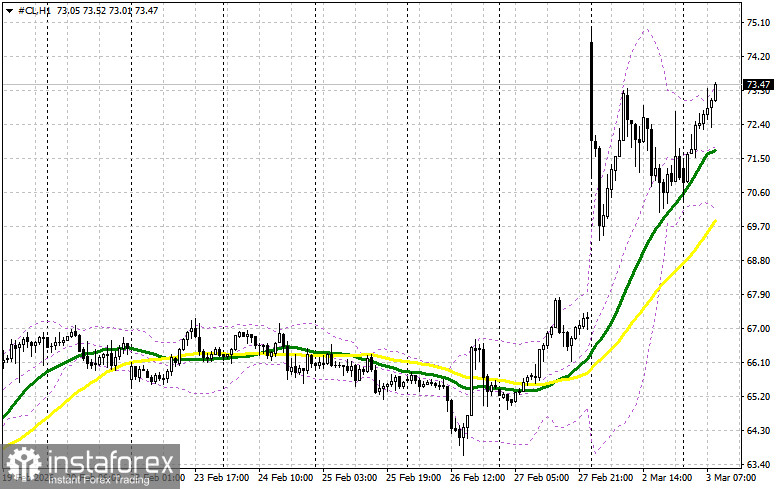
Brent crude rose above $80 per barrel after a roughly 7% jump on Monday, while West Texas Intermediate crude approached the $73 mark. Yesterday, President Donald Trump stated that the US would do whatever it takes, and Secretary of State Marco Rubio informed reporters that the military campaign would only intensify.
According to the Saudi Ministry of Defense, the US embassy in the capital was attacked by two drones, resulting in a small fire and minor material damage. Earlier, the US State Department urged all American citizens to leave the Middle East due to serious security threats.
Ibrahim Jabari, an advisor to the commander of the Islamic Revolutionary Guard Corps in Iran, told state television that troops will attack any vessel attempting to pass through the Strait of Hormuz. It appears the Strait has already closed, which will further increase oil prices in the near future.
It is noteworthy that global energy markets were shaken by the war that erupted last Saturday and then spread across the oil-rich Middle East. Prices have sharply increased not only for oil but also for natural gas and petroleum products such as diesel, potentially triggering a wave of inflation worldwide. Coal prices also surged.
As the Strait of Hormuz remains inactive, time goes on, and some producers in the Persian Gulf may have to cut production in the coming weeks if storage tanks fill up. For now, the price increase remains restrained—despite the overwhelming geographical scale of the conflict and the growing proximity to energy infrastructure—reflecting the fact that a significant risk premium is already priced into current prices. Should the conflict worsen, a new upward market movement may occur.
Yesterday, Saudi Aramco suspended operations at its refinery in Ras Tanura following a drone strike in the area. Qatar halted production of liquefied natural gas at the world's largest export facility after it became a target of an Iranian attack.
As I mentioned earlier, tanker traffic through the Strait of Hormuz has also stopped due to existing risks. It is worth reminding that one-fifth of global oil supplies and a similar share of liquefied natural gas pass through this narrow strait off the coast of Iran. Cargoes traveling through this waterway typically come from Iran and other regional producers, including Saudi Arabia, to global markets.
Saudi Arabia, Iraq, Kuwait, and the United Arab Emirates began ramping up oil exports last month, and OPEC+ agreed over the weekend to resume increasing production in April. However, whether these countries can continue to ramp up exports will depend on passage through the Strait of Hormuz.
Many experts believe WTI crude will trade in a range of $72 to $75, with $75 as the upper limit.


