
See also


 17.04.2026 08:38 AM
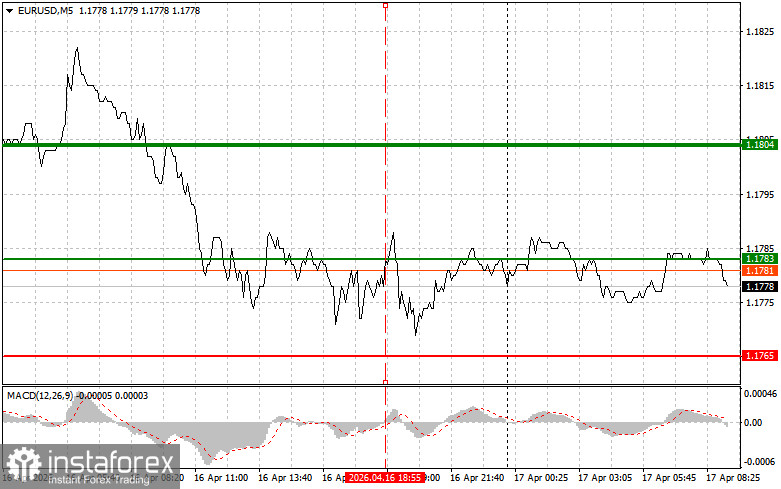
The price test at 1.1783 coincided with the MACD indicator just beginning to move upward from the zero mark, confirming a valid entry point for buying the euro. However, the anticipated large upward movement did not materialize.
Positive news on U.S. weekly jobless claims, which came in better than economists' forecasts, led to further selling of the euro. Despite the latest data from the Eurozone indicating rising inflation and ongoing uncertainty around the European Central Bank's future decisions, traders are confident that the central bank will not change its policy at the next meeting. This has been a significant moment in the current situation for profit-taking on long positions in the EUR/USD pair following a substantial weekly rise.
In the first half of today, we are expecting only figures on the ECB's current account balance and the Eurozone's trade balance. Although these indicators may seem less significant to retail investors than interest rate decisions or inflation reports, they play a crucial role in shaping a general understanding of the economic situation in the Eurozone. The current account balance reflects the volume of a country or region's international transactions, including trade in goods and services, as well as income flows and transfers. A positive balance may signal strong export potential and stability in the external economy, while a negative one could indicate increasing dependence on imports or capital outflows. The trade balance, on the other hand, focuses solely on the difference between the value of exports and imports of goods. For the Eurozone, a major player in the global market, the dynamics of external trade are of paramount importance. Positive data could support the euro, but it is unlikely to result in significant changes in market positioning.
As for the intraday strategy, I will primarily rely on the implementation of Scenarios #1 and #2.
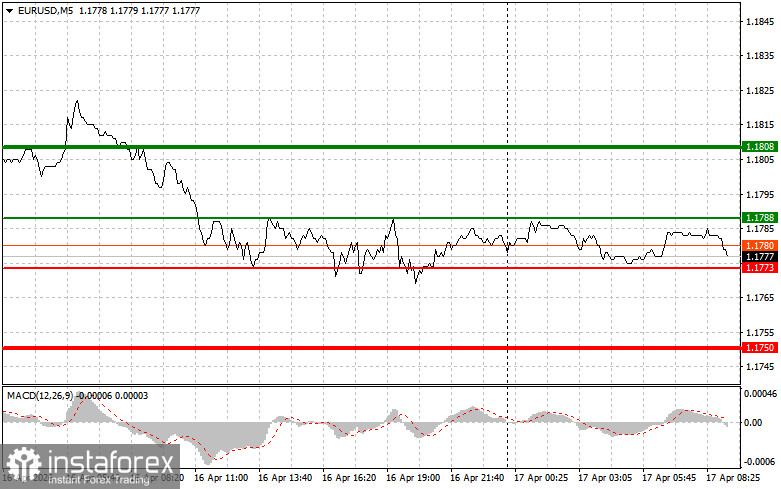
Scenario #1: Today, I plan to buy the euro at a price around 1.1788 (green line on the chart), targeting a rise to 1.1808. At 1.1808, I plan to exit the market and also sell the euro in the opposite direction, anticipating a movement of 30-35 pips from the entry point. It is reasonable to expect the euro to rise only after good data today. Important! Before buying, ensure that the MACD indicator is above the zero mark and is just beginning its upward movement from there.
Scenario #2: I also intend to buy the euro today if the price tests 1.1773 twice in a row while the MACD indicator is oversold. This will limit the pair's downside potential and lead to an upward market reversal. One can expect growth toward the opposing levels of 1.1788 and 1.1808.
Scenario #1: I plan to sell the euro once it reaches 1.1773 (red line on the chart). The target will be the level of 1.1750, where I intend to exit my short positions and immediately open long positions in the opposite direction (anticipating a movement of 20-25 pips in the opposite direction from the level). Pressure on the pair today may persist within the observed correction. Important! Before selling, ensure that the MACD indicator is below the zero mark and is just beginning its downward movement from there.
Scenario #2: I also plan to sell the euro today if the price tests 1.1788 twice in a row while the MACD is in the overbought area. This will limit the pair's upside potential and lead to a market reversal downward. One can expect a decline to the opposing levels of 1.1773 and 1.1750.
Important: Beginner traders in the Forex market need to be very cautious when making entry decisions. It is best to be out of the market before important fundamental reports are released to avoid being caught in sharp price fluctuations. If you choose to trade during news releases, always set stop orders to minimize losses. Without setting stop orders, you can quickly lose your entire deposit, especially if you do not use money management and trade large volumes.
And remember, for successful trading, it is essential to have a clear trading plan, like the one presented above. Spontaneous trading decisions based on the current market situation are inherently a losing strategy for intraday traders.


