
See also


 01.09.2026 08:33 AM
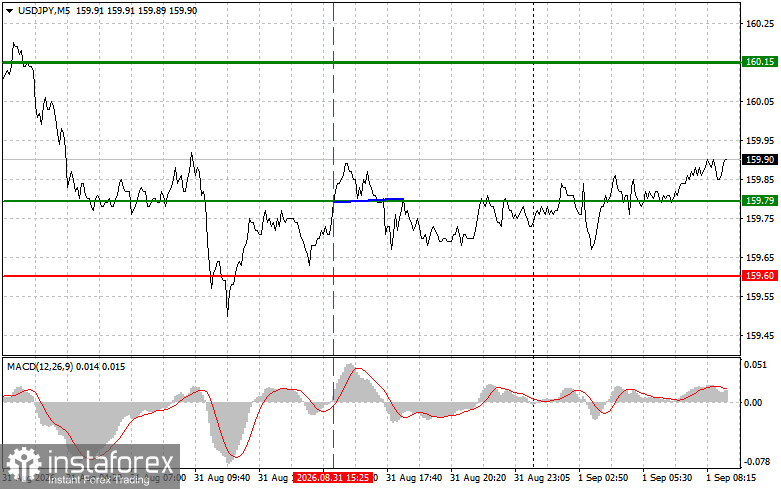
The price test at 159.79 occurred as the MACD indicator began moving upward from the zero mark, confirming the correct entry point to buy the dollar. However, the pair did not experience significant growth.
The lack of important data from the U.S. yesterday was the main reason for the dollar's slight retreat against riskier assets. For the yen, the temporary weakness of the dollar provided some relief, and the USD/JPY pair declined slightly; however, the divergent approaches of the decisive Federal Reserve and the much more cautious Bank of Japan continue to pressure the Japanese currency. This contrast in policy has prevented the yen from achieving any recovery.
Today's weak report on Japan's manufacturing PMI, which fell to 54.9, put pressure on the yen and led to an increase in the USD/JPY pair. The business activity index is based on company surveys and reflects the state of the industry, with values above 50 indicating growth and below indicating a decline. Thus, the weak result below forecasts signaled a cooling in the sector. However, this does not necessarily indicate weakness in the Japanese economy, as manufacturing activity remains at a relatively high level.
Regarding the intraday strategy, I will focus on implementing scenarios #1 and #2.
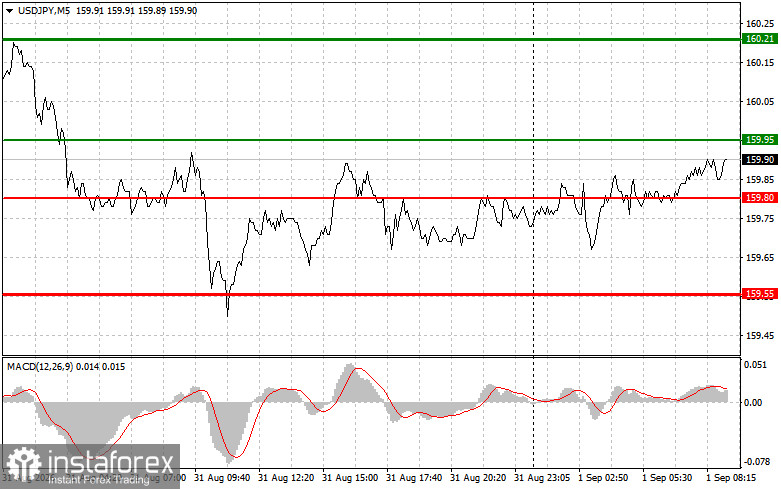
Scenario #1: I plan to buy USD/JPY today upon reaching an entry point around 159.95 (the green line on the chart), targeting growth to the level of 160.21 (the thicker green line on the chart). At around 160.21, I intend to exit my long positions and open short positions in the opposite direction (anticipating a movement of 30-35 pips in the opposite direction from the level). It is best to return to buying the pair on corrections and significant dips in USD/JPY. Important! Before buying, ensure that the MACD indicator is above the zero mark and just starting to rise from it.
Scenario #2: I also plan to buy USD/JPY today in the event of two consecutive tests of 159.80, with the MACD indicator in the oversold area. This will limit the pair's downside potential and lead to an upward market reversal. Growth can be expected towards opposing levels of 159.95 and 160.21.
Scenario #1: I plan to sell USD/JPY today only after the 159.80 level is updated (the red line on the chart), which will trigger a rapid decline in the pair. The key target for sellers will be 159.55, where I plan to exit my short positions and buy back immediately (anticipating a move of 20-25 pips in the opposite direction from that level). Sellers may return at any moment, so any signal from the central bank will be significant. Important! Before selling, ensure that the MACD indicator is below the zero mark and just starting to decline from it.
Scenario #2: I also plan to sell USD/JPY today if there are two consecutive tests of 159.95 while the MACD indicator is in the overbought area. This will limit the pair's upward potential and lead to a downward market reversal. A decline can be expected towards opposing levels of 159.80 and 159.55.
Important: Beginner traders in the Forex market need to be very cautious when making entry decisions. It is best to stay out of the market ahead of significant fundamental reports to avoid being caught in sharp price fluctuations. If you decide to trade during news releases, always set stop orders to minimize losses. Without stop orders, you can quickly lose your entire deposit, especially if you do not employ money management practices and trade large volumes.
Also, remember that successful trading requires a clear trading plan, similar to the one provided above. Making spontaneous trading decisions based on current market conditions is inherently a losing strategy for intraday traders.


