
Lihat juga


 01.06.2026 01:13 PM
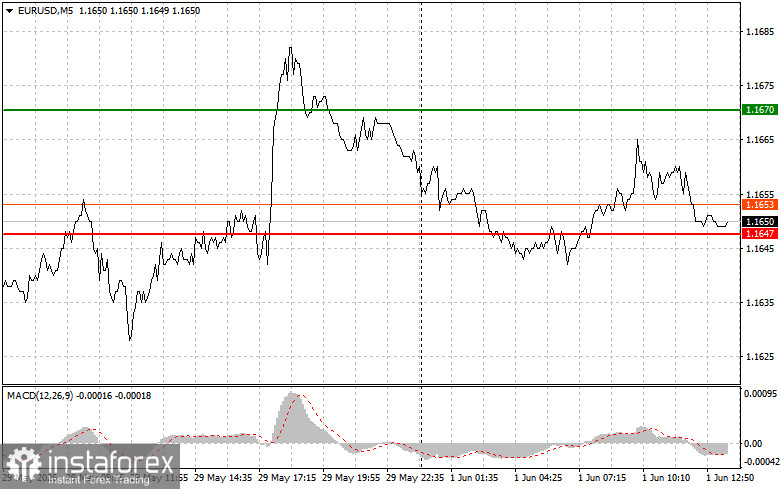
Due to low volatility, the test of the levels I outlined did not take place. As a result, I ended the day without any trades.
The Eurozone Manufacturing PMI declined to 51.3 from 52.3 in April, indicating continued expansion but with weakening momentum. This slowdown, while not critical, has now persisted for the second consecutive month, signaling some cooling in the industrial sector, which is causing caution among market participants. According to experts, the main reasons for this decline include continued inflationary pressure, slowing global demand, and ongoing geopolitical tensions. Companies are facing rising costs for raw materials and energy, forcing them either to pass these costs on to consumers or reduce production volumes in order to maintain margins.
Next, we will see similar data from the U.S. ISM Manufacturing PMI. Strong figures would restore demand for the U.S. dollar, while weak data could trigger renewed downward pressure on the currency. An increase in manufacturing activity typically correlates with higher employment and rising consumer spending, which in turn supports overall business confidence. Given the recent mixed performance of these indicators, strong dollar appreciation following the release is unlikely.
Regarding the intraday strategy, I will primarily rely on scenarios No. 1 and No. 2.
Buy Signal
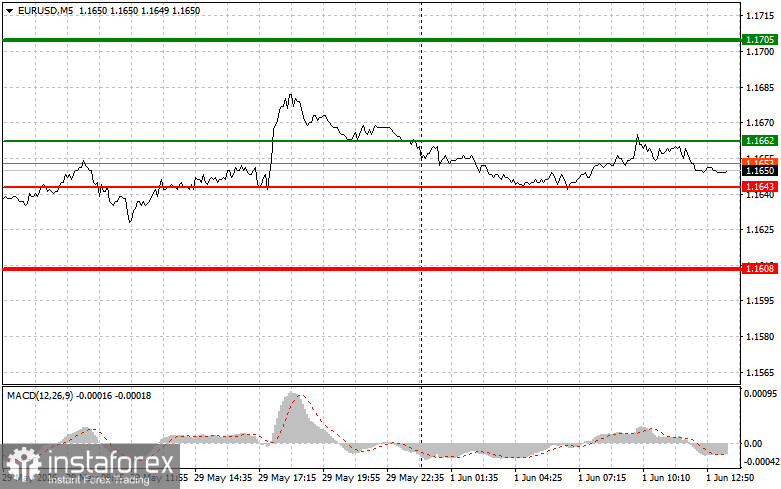
Today, euro purchases may be considered at a price around 1.1662 (green line on the chart), targeting a rise toward 1.1705. At 1.1705, I plan to exit the market and also consider short positions in the opposite direction, expecting a pullback of 30–35 points from the entry point. A rise in the euro today is only possible in the case of strong positive news. Important: Before buying, ensure that the MACD indicator is above the zero line and has just started to rise from it.
I will also consider buying the euro if the price tests 1.1643 twice in a row while the MACD is in oversold territory. This would limit the downward potential of the pair and lead to a reversal to the upside. In this case, a rise toward 1.1662 and 1.1705 can be expected.
Sell Signal
I plan to sell the euro after a move to 1.1643 (red line on the chart). The target is 1.1589, where I will exit the market and immediately consider buying in the opposite direction, expecting a 20–25 point rebound. Selling pressure may return today if strong U.S. data is released. Important: Before selling, ensure that the MACD indicator is below the zero line and has just started to decline from it.
I will also consider selling the euro if the price tests 1.1662 twice in a row while the MACD is in overbought territory. This would limit the upward potential and lead to a reversal downward. A decline toward 1.1643 and 1.1608 can be expected.
What is shown on the chart:
Important Note
Beginner Forex traders should approach market entry decisions with extreme caution. Before major fundamental data releases, it is best to stay out of the market to avoid sharp volatility. If you decide to trade during news releases, always use stop-loss orders to minimize losses. Without stop-loss protection, you may quickly lose your entire deposit, especially if risk management is not applied and large position sizes are used.
Remember that successful trading requires a clear trading plan, similar to the one outlined above. Spontaneous trading decisions based on current market conditions are, by definition, a losing strategy for intraday traders.


