
यह भी देखें


 17.04.2026 08:38 AM
The price test at 1.3540 occurred when the MACD indicator was just beginning to move upward from the zero mark, confirming a correct entry point for buying the pound. However, after a 10-pip rise, demand for the pound decreased.
The British pound declined sharply against the U.S. dollar, driven by a swift decline in news events that had been stimulating demand for risk assets. Even the fact that the UK's Gross Domestic Product grew did not help the pair move upward. Data showing that the number of jobless claims in the U.S. came in below economists' forecasts only intensified the pressure on the pair in the second half of the day.
Today, the only significant event expected is the speech from Bank of England Monetary Policy Committee member Huw Pill. This event may become the sole significant point on the economic calendar for the day, capable of providing some clarity on market sentiment. In the absence of other major macroeconomic releases, the words of one of the key figures shaping interest rate decisions will be closely analyzed for hints on the future trajectory of monetary policy.
Regarding the intraday strategy, I will primarily rely on implementing Scenarios #1 and #2.
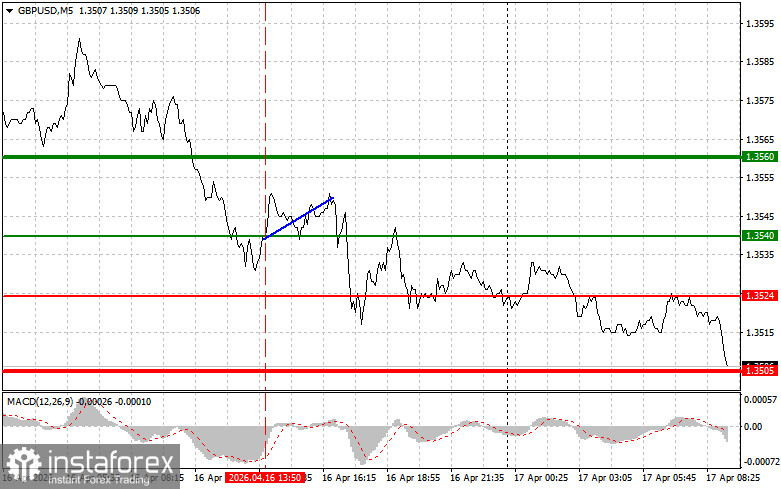
Scenario #1: I plan to buy the pound today upon reaching an entry point around 1.3525 (green line on the chart), targeting a move to 1.3560 (thicker green line on the chart). At 1.3560, I plan to exit my long positions and also sell the pound in the opposite direction, anticipating a movement of 30-35 pips from the entry point. It is unlikely that the pound will see significant growth today. Important! Before buying, ensure that the MACD indicator is above the zero mark and is just beginning its upward movement from there.
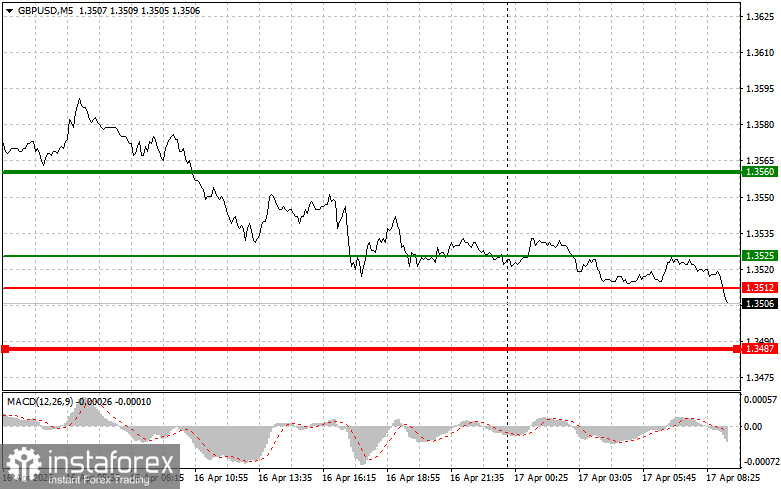
Scenario #2: I also plan to buy the pound today if the price tests 1.3512 twice in a row while the MACD indicator is in the oversold area. This will limit the pair's downside potential and lead to an upward market reversal. One can expect growth toward the opposing levels of 1.3525 and 1.3560.
Scenario #1: I plan to sell the pound after updating the level to 1.3512 (red line on the chart), which will trigger a rapid decline in the pair. The key target for sellers will be the level of 1.3487, where I plan to exit my short positions and immediately open longs in the opposite direction (anticipating a movement of 20-25 pips in the opposite direction from the level). Pressure on the pound may persist if tensions between the U.S. and Iran escalate. Important! Before selling, ensure that the MACD indicator is below the zero mark and is just beginning its downward movement from there.
Scenario #2: I also plan to sell the pound today in the case of two consecutive tests of the price at 1.3525 when the MACD is in the overbought area. This will limit the upward potential of the pair and lead to a market reversal downward. One can expect a decline to the opposing levels of 1.3512 and 1.3487.
Important: Beginner traders in the Forex market need to be very cautious when making entry decisions. It is best to be out of the market before important fundamental reports are released to avoid being caught in sharp price fluctuations. If you choose to trade during news releases, always set stop orders to minimize losses. Without setting stop orders, you can quickly lose your entire deposit, especially if you do not use money management and trade large volumes.
And remember, for successful trading, it is essential to have a clear trading plan, like the one presented above. Spontaneous trading decisions based on the current market situation are inherently a losing strategy for intraday traders.

