
यह भी देखें


 31.08.2026 07:43 PM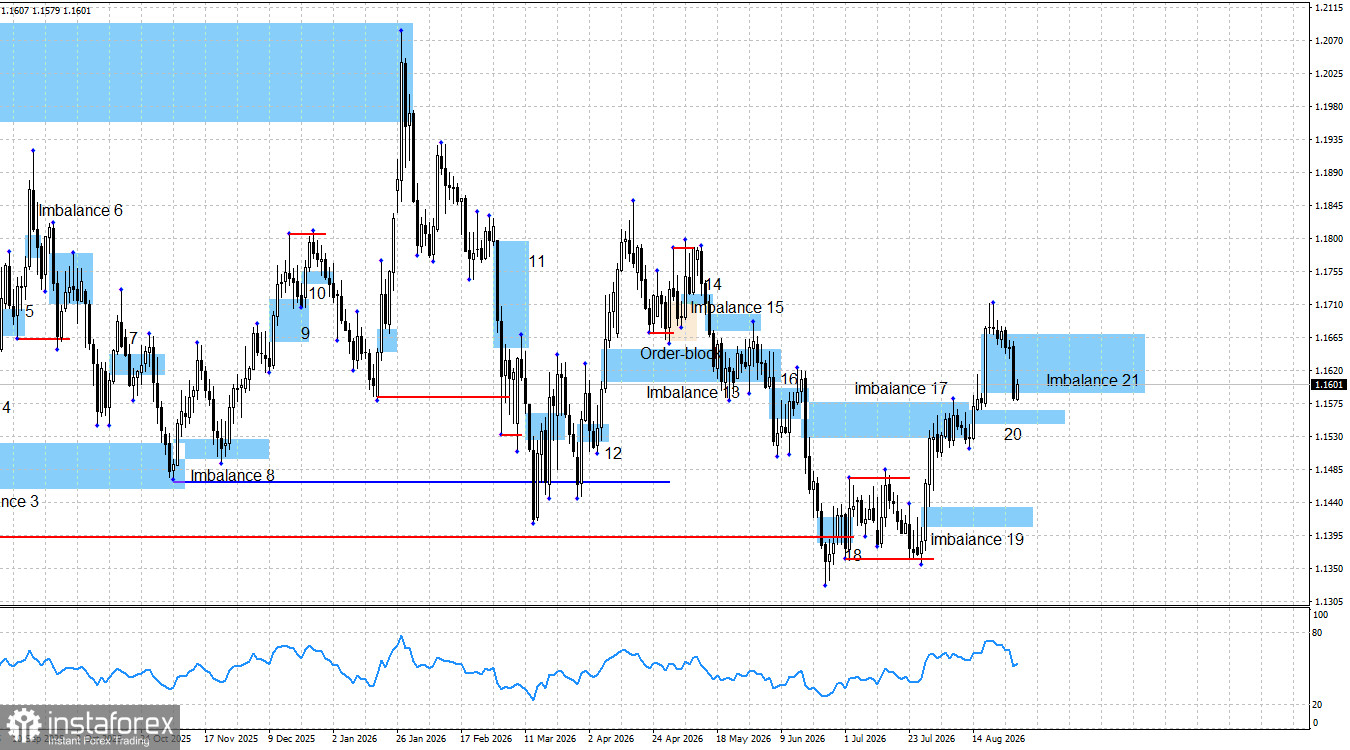
The EUR/USD pair had been declining for six days, but the bears' advance may now be coming to an end. Overall, it can be said with confidence that the bears mounted a genuine attack only last Friday, when FOMC President Kevin Warsh first delivered a speech, followed by a revision to the annual Nonfarm Payrolls data. Neither of these events was unequivocally bearish, yet the bears' attack was not surprising, as reasons to buy the US currency could still be found if one looked for them. As I wrote earlier, the Nonfarm Payrolls report could have been much worse than it ultimately turned out to be, while Warsh's speech contained some renewed hawkish signals. However, if we call things by their proper names and do not try to see white in black, I see no reason for the dollar to rise. The Nonfarm Payrolls report showed a negative figure, while Kevin Warsh merely spoke about high inflation and did not promise to raise interest rates. The euro's price declined to the base of imbalance 21, and the decline has stopped there for now. There will be plenty of important economic data this week, so the bears may still receive additional support.
In my view, the fundamental backdrop continues to fully support the bulls. First, any chart clearly shows that the euro began its rise from relatively low levels compared with its average price over the past year. This means that it still has room to rise. Second, the market doubts that the FOMC will tighten monetary policy in September. Third, the market has begun to question whether the Fed under Kevin Warsh can tighten monetary policy at all. Fourth, US economic data have recently brought nothing but disappointment. Fifth, geopolitical developments no longer support the bears or the dollar. Sixth, the ECB may implement another monetary policy tightening this autumn. Seventh, the US Treasury has decided to increase its purchases of long-term bonds, reducing demand for the dollar. Eighth, a new trade war may begin soon between the United States and Canada and between the United States and China. Ninth, the US labor market is contracting, while inflation has nevertheless been declining in recent months. Thus, I see not a single reason for a bearish advance.
The latest US labor market data showed weak figures, inflation has slowed, and GDP growth has lost momentum. These three factors have raised doubts about an FOMC rate hike not only in September but also in the foreseeable future. This is precisely the factor that supported the bears as recently as June but has now turned against them. In my view, the bears' only current opportunity lies in a new escalation in the Middle East. However, Donald Trump is not inclined toward military escalation. He now wants to put economic pressure on Iran.
The current chart setup indicates that the bullish momentum is being maintained. The price has completely filled the latest bullish imbalance 21 and may even reach the previous bullish imbalance 20. The combined reaction to these two patterns could bring the bulls back into the market, and the upward move could resume. If one or both patterns are invalidated, the bears will be able to launch their own advance, but there is no indication of this so far.
The economic backdrop on Monday did not support the euro's rise. The day's only inflation report, from Germany, came in below traders' expectations, which means that the chances of an ECB monetary policy tightening in September are declining. Of course, everything will depend on tomorrow's inflation report for the European Union. However, Germany's inflation data gave the euro little reason for optimism.
There remain a huge number of reasons for the bulls to attack in 2026, and even the outbreak of war in the Middle East has not reduced their number. Structurally and globally, Trump's policies, which led to a significant decline in the dollar last year, have not changed. At present, I see no significant factors supporting the US currency, despite the FOMC's formally hawkish stance. Geopolitical developments, which supported demand for the US currency for most of the first half of 2026, are no longer doing so. The conflict in the Middle East remains unresolved, but there have been no new hostilities from either Iran or the United States.
News calendar for the United States and the European Union:
On September 1, the economic calendar contains four events, of which I would highlight the ISM index and inflation in Europe. Economic data may influence market sentiment on Tuesday.
EUR/USD forecast and trading advice:
In my view, the pair remains in the process of forming a bullish trend. The fundamental backdrop shifted sharply in favor of the bears six months ago, but the trend itself cannot be considered canceled or complete. Thus, the bulls may well continue their advance after two liquidity sweeps of clearly defined lows. At present, bullish traders have an excellent support level in the form of imbalance 21. A new buy signal may form within this imbalance or imbalance 20. I see 1.1797 and 1.1850 as the targets for the euro's rise.

