
यह भी देखें


 02.09.2026 06:43 PM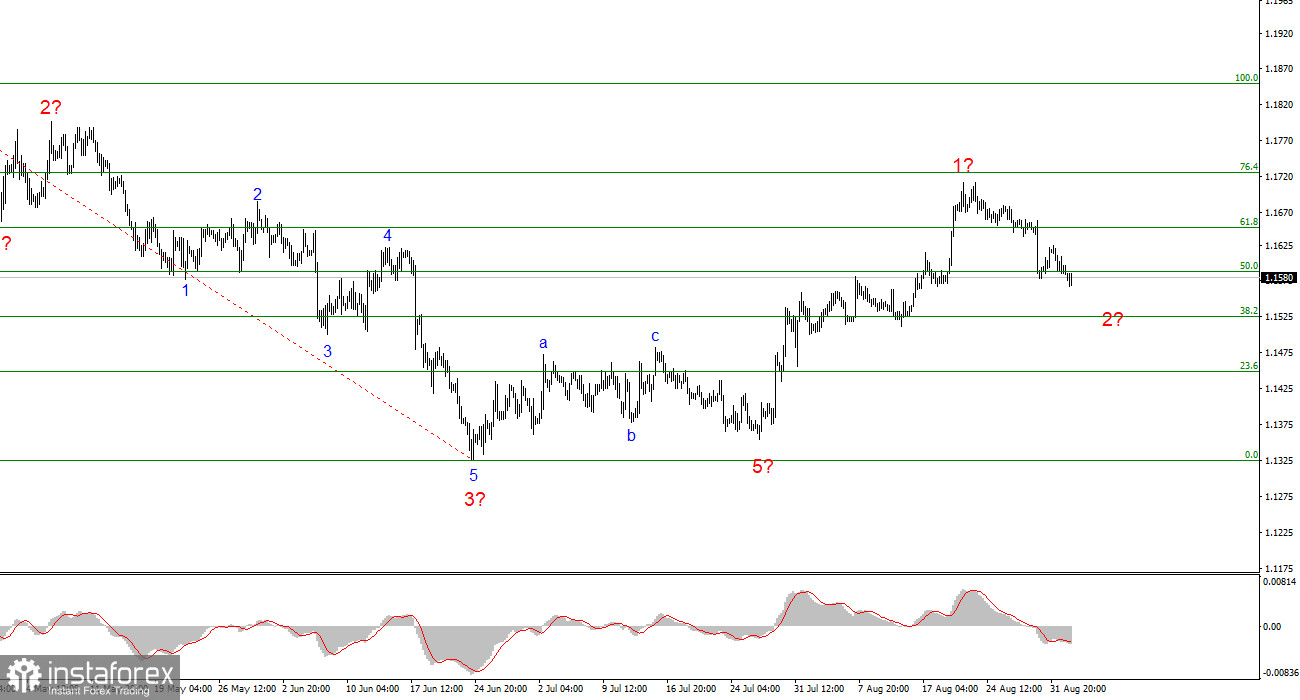
The wave count on the 4-hour chart for EUR/USD is becoming more complex. There is still no question of canceling the upward section of the trend (lower chart), which began in January last year. On the contrary, we saw a complete corrective A-B-C structure, which has most likely been completed. We never got the convincing wave 5 of C that we were expecting. This wave took a truncated form, which also occurs from time to time. Let me remind you that classical wave structures are generally found only in textbooks. In real life, traders and analysts should be more flexible in their analysis.
Unfortunately, the wave count may once again become more complex at present. Wave C may take a three-wave form, the wave following it will be identified as wave D, and the entire trend section beginning on January 27 will take the form of a five-wave corrective A-B-C-D-E structure. If this assumption is correct, wave D is taking a three-wave form, and on August 21, EUR/USD entered the phase of forming wave E, whose low should be below the low of wave C — 1.1325.
None of the reports this week supported the dollar. But the dollar is rising.
The EUR/USD exchange rate declined by 15 basis points during Wednesday's trading. Market movements are currently extremely strange because demand for the U.S. currency has been steadily increasing this week, even though there has not been a single economic event in favor of the U.S. dollar. The week's economic hit parade began with the inflation report from the European Union. Despite the fact that the Consumer Price Index rose to 3.3%, significantly increasing the likelihood of an ECB monetary policy tightening as early as September, the market did not consider the report sufficient reason to buy the euro. Next came the U.S. ISM Manufacturing PMI, which came in below market expectations but also failed to trigger any strengthening of the euro. The JOLTS report also failed to please traders with the number of job openings in the United States. Today, the ADP report was released, and its figure also came in below market expectations — just 38,000. This figure is extremely weak in itself, so I am not even interested in what level the forecasts were at. In any case, the forecasts were higher.
This means that all the reports this week supported the European currency, yet for some reason the dollar is rising. This phenomenon can only be explained by a sharp increase in expectations of a hawkish Fed decision at the September meeting. And hawkish expectations began to rise after Kevin Warsh's speech at the Jackson Hole symposium. In my view, the market is once again mistaken, and sentiment may deteriorate sharply as early as Friday, following the release of unemployment and payroll data. However, there is nothing preventing market participants from constantly changing their expectations. Let me remind you that a month ago, the probability of a Fed rate hike in September was estimated at 70–80%, a week ago it did not exceed 33%, and now it is back to almost 70%.
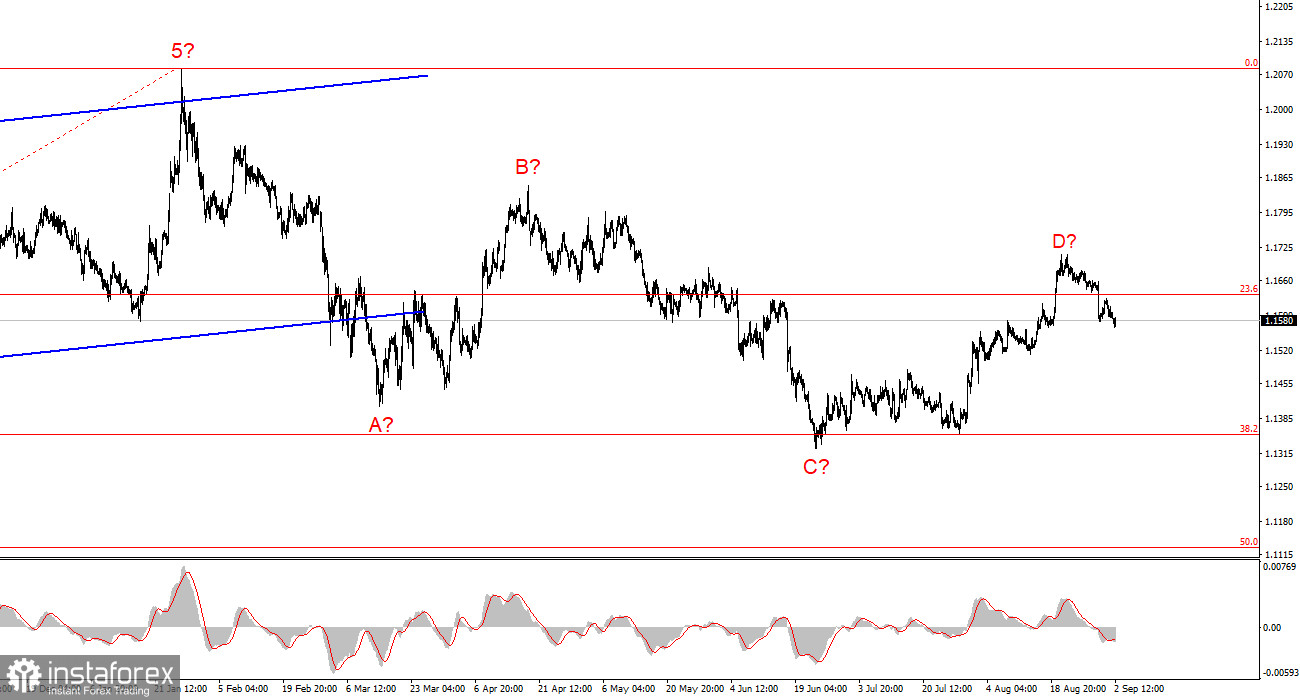
Based on my EUR/USD analysis, I conclude that the instrument remains within a corrective downward section of the trend (lower chart), which is becoming increasingly complex. It appears that this trend section will take the form of A-B-C-D-E. If this is indeed the case, the decline in prices will continue, with targets located below the low of wave C — 1.1325. If so, now is a good time to establish short positions, as the instrument has downward potential of at least 350 points.
On the higher timeframe, an upward section of the trend can be seen, after which a corrective wave sequence began to form. The A-B-C structure is presumably complete. If this is the case, a new impulsive upward section of the trend has begun to form.
The main principles of my analysis:

