
یہ بھی دیکھیں


 19.06.2026 08:32 AM
Oil finishes the week down about 9%—Brent is trading at $79 per barrel, while WTI is around $77. Futures have virtually lost all the gains accumulated during the war with Iran. This historic movement marks the largest supply shock in oil market history and is beginning to reverse.
Physical signs of normalization are appearing rapidly, something many analysts likely did not expect, predicting that prices would remain high due to difficulties in normalizing production and exports, with Iran playing a key role in this dynamic.
On Thursday, vessels carrying nearly 10 million barrels of oil either passed through the strait or were in transit—including the first Saudi tankers since the conflict began over three months ago. U.S. Vice President Vance reported yesterday that 12.5 million barrels passed through the strait in just one night. ADNOC has notified customers about the resumption of crude oil shipments from the Persian Gulf ports. Kuwait has announced an increase in production. In peacetime, about 20 million barrels passed through the strait daily—while that level is still a distance away, the direction of movement is clear.
Trump, speaking on social media, welcomed the developments and dismissed criticisms from hawks who consider the deal too lenient towards Tehran: "The markets are thrilled—oil has collapsed, and stocks have risen." This is a politically significant moment: the drop in oil prices directly affects gasoline prices, thereby strengthening Trump's position ahead of the midterm elections in November. That is why he is interested in the swift opening of the strait.
However, it is important not to rush to conclusions about full normalization. Trust is fragile, and a lot still needs to be done to rebuild it. Goldman Sachs estimates that complete restoration of production through the strait to pre-war levels of 20 million barrels per day will reach 50% by September and 80% by December—even in an optimistic scenario, this will take months.
For financial markets, the key question has now shifted from oil prices to the trajectory of interest rates. The decline of Brent from a peak of over $108 to $79 is a powerful disinflationary impulse that will be visible in the CPI data in the upcoming July and August releases. If oil holds at current levels or drops further, the Federal Reserve will have a strong argument against raising rates this year—and market expectations, which have priced in a hike by October with about a 60% probability, will start to be reassessed. This shift will determine the dynamics of the dollar, bonds, and gold in the upcoming weeks.
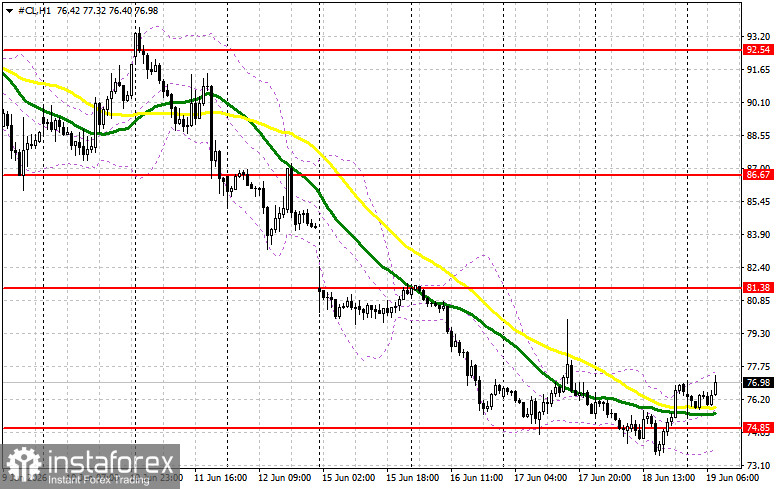
Regarding the current technical picture for oil, buyers need to reclaim the nearest resistance at $81.40. This will allow them to target $86.67, above which it will be quite challenging to break through. The further target will be around $92.54. In the event of a decline in oil prices, bears will attempt to take control of $74.85. If they succeed, a breakout of this range will deal a serious blow to the bulls' positions and could push oil down to a low of $67.77 with the potential to reach $59.90.


