
یہ بھی دیکھیں


 22.10.2026 04:02 AM
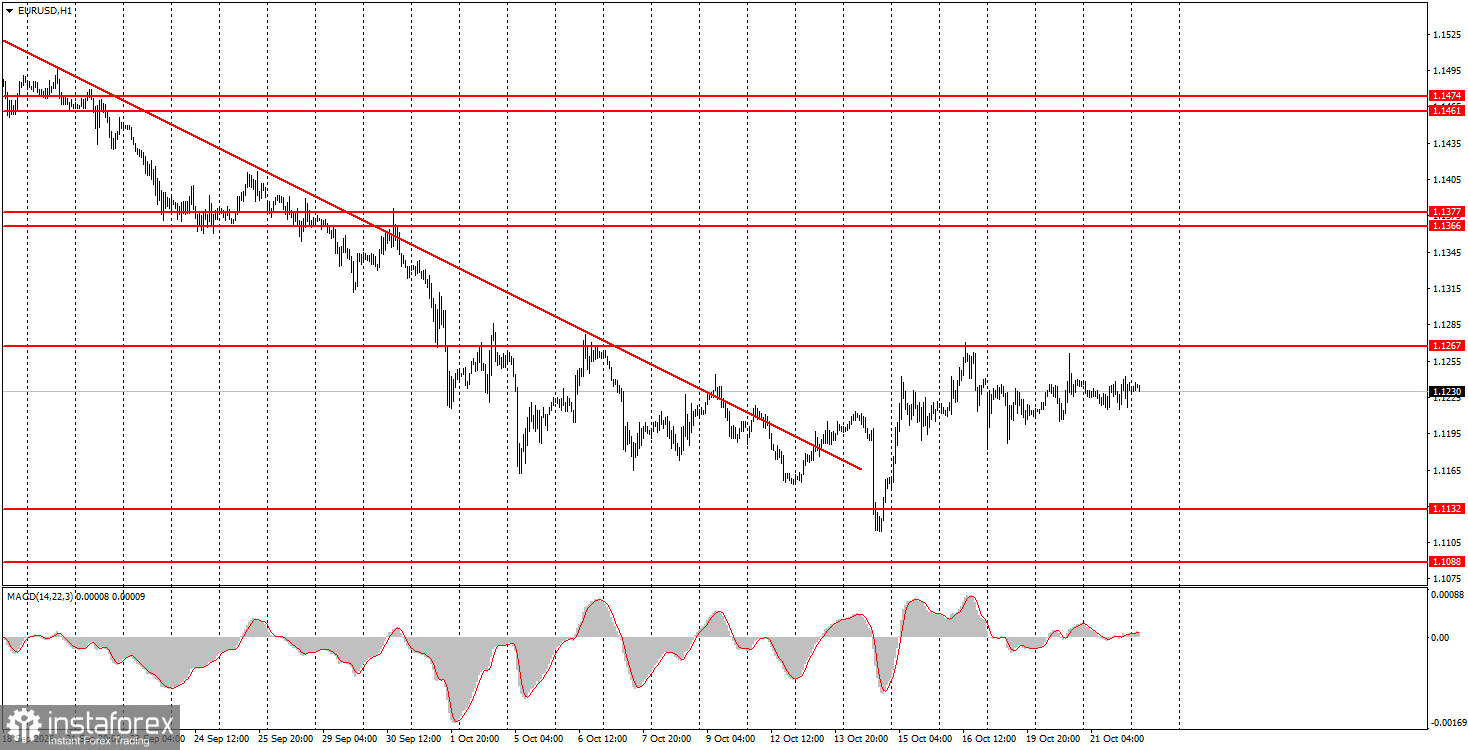
The EUR/USD currency pair showed no desire to move in any direction on Wednesday. No notable events occurred in the U.S. or the EU during the day, and Christine Lagarde's speech provided no new information to the market. Thus, volatility on the third trading day of the week was minimal, and the euro still cannot show even a noticeable correction. The descending trend line has been broken, but that makes no sense because the euro cannot overcome the nearest resistance level. At the moment, everything looks as if the euro will resume its decline even without a correction. We see no grounds for a new rise in the dollar after its month-long rally, but the market shows it is not going to cut short positions and get rid of the U.S. currency. If no one sells the dollar, the euro won't rise. There are very few important events this week, so we may face sluggish low-volatility moves until the end of the week.
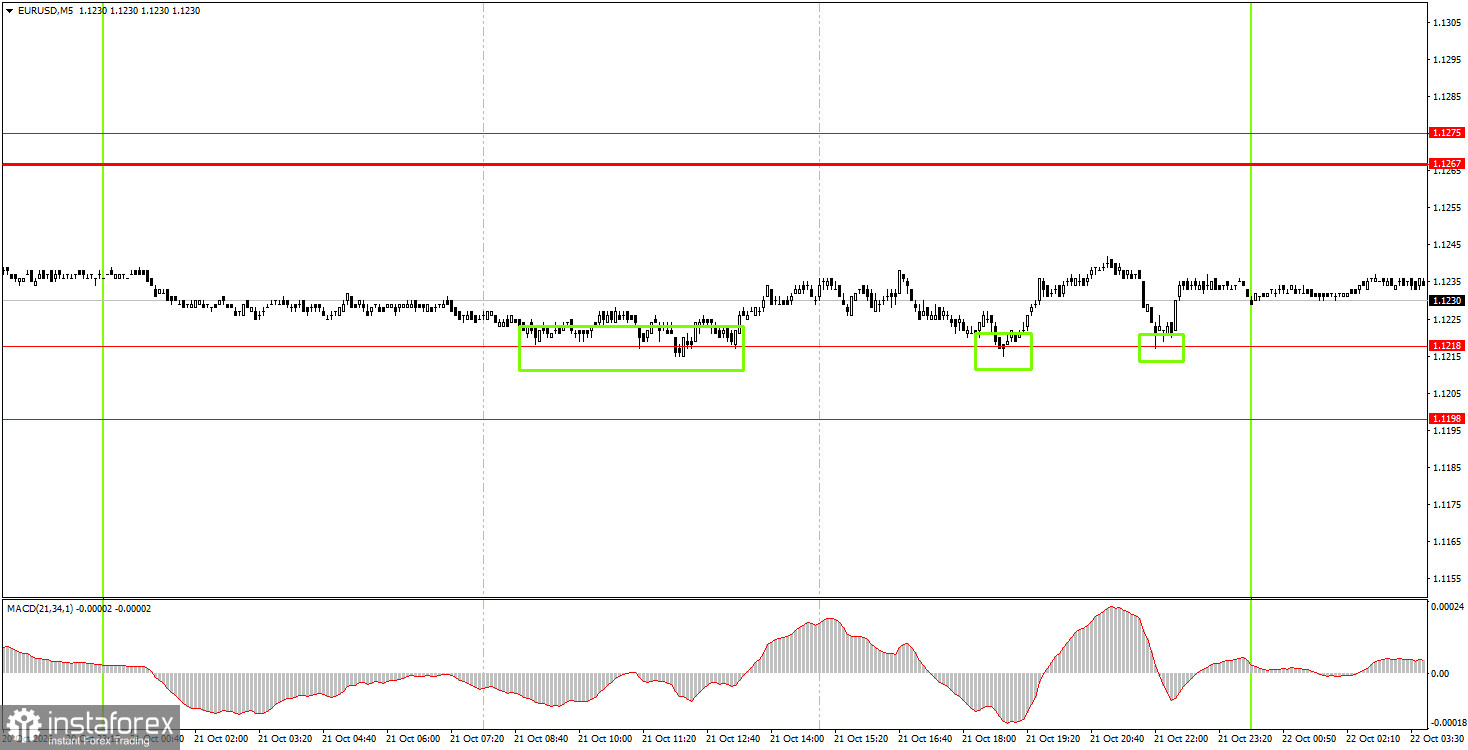
On the 5-minute TF, three decent buy signals formed on Wednesday. Price bounced three times off the 1.1218 level. It bounced very precisely and punctually. But it was extremely difficult to profit well on these signals because intraday volatility was low.
On the hourly timeframe, EUR/USD retains a downward tendency that is a full-fledged trend, but there are reasons to believe the trend is finished. Given the events of recent months, we don't think the euro should have fallen like a stone. At the moment, the dollar is heavily overbought, and many euro-bullish factors have been ignored.
On Thursday, novice traders can consider new short positions if the pair holds below the 1.1198–1.1218 area, targeting 1.1132–1.1140. Open long positions on a new bounce from the 1.1198–1.1218 area, targeting 1.1267–1.1275.
On the 5-minute TF consider the levels 1.1011, 1.1088, 1.1132–1.1140, 1.1198–1.1218, 1.1267–1.1275, 1.1366–1.1377, 1.1461–1.1474, 1.1527–1.1531, 1.1584–1.1594, 1.1655–1.1665. No interesting events or releases are scheduled in the EU for Thursday, and the U.S. will release a tertiary report on initial jobless claims. We can expect low-volatility, sideways trading today as well.
Price levels (areas) of support and resistance serve as targets for opening buy or sell trades or as sources of signals.
Red lines indicate channels or trend lines that show the current trend and the preferred trading direction.
The MACD indicator (14,22,3) — the histogram and signal line — is an auxiliary indicator that can also provide signals.
Important speeches and reports (listed in the news calendar) can significantly influence currency pair movements. Therefore, during their release, traders should approach trading with utmost caution, or exit the market to avoid sudden reversals against the preceding move.
Beginner forex traders should remember that not every trade can be profitable. Developing a clear strategy and practicing money management are key to long-term success in trading.


