
Veja também


 14.01.2026 06:35 PM
Trade review and trading tips for the European currency
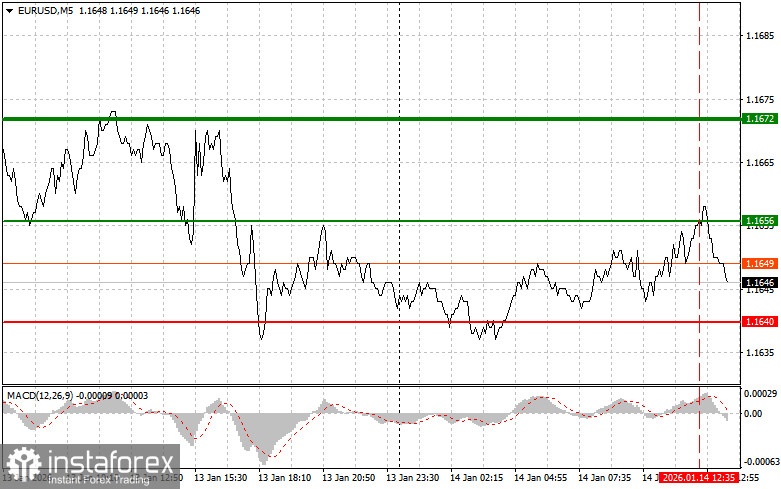
The test of the 1.1656 price level occurred when the MACD indicator had already moved a long way above the zero line, which limited the pair's further upward potential. For this reason, I did not buy the euro.
The lack of economic data from the eurozone affected fluctuations in the EUR/USD pair, keeping trading within a narrow sideways range. By choosing a wait-and-see approach, traders preferred to avoid risk, which led to lower trading volumes. Apparently, the majority of market participants are expecting larger moves in the second half of the day, after the release of a number of statistics related to U.S. inflation.
Close attention should be paid to several U.S. economic reports, including the Producer Price Index, retail sales dynamics, and existing home sales data. Public speeches by Federal Open Market Committee members Neel Kashkari, Raphael Bostic, and John Williams are also scheduled. The Producer Price Index will help assess the scale of inflation in the U.S. economy, which is extremely important for forecasting future Federal Reserve policy. A decline in producer prices could temporarily weaken the dollar. Retail sales data will provide insight into consumer activity, which is one of the main drivers of economic growth. An increase in retail sales typically reflects consumer optimism and favorable economic prospects, while a decline may signal a slowdown.
Speeches by Kashkari, Bostic, and Williams may shed light on the Fed's future plans regarding monetary policy. Investors will closely analyze their comments on inflation, economic growth prospects, and expected changes in interest rates.
As for the intraday strategy, I will rely more on the implementation of Scenarios No. 1 and No. 2.
Buy Signal
Scenario No. 1: Today, the euro can be bought if the price reaches the 1.1656 level (green line on the chart), with a target of growth toward the 1.1672 level. At 1.1672, I plan to exit the market and also sell the euro in the opposite direction, expecting a move of 30–35 points from the entry point. Strong euro growth can be expected after a decline in U.S. inflation.Important! Before buying, make sure that the MACD indicator is above the zero line and is just beginning to rise from it.
Scenario No. 2: I also plan to buy the euro today in the case of two consecutive tests of the 1.1640 price level at a time when the MACD indicator is in the oversold area. This will limit the pair's downward potential and lead to a reversal of the market upward. Growth toward the opposite levels of 1.1656 and 1.1672 can be expected.
Sell Signal
Scenario No. 1: I plan to sell the euro after the price reaches the 1.1640 level (red line on the chart). The target will be the 1.1621 level, where I plan to exit the market and immediately buy in the opposite direction (expecting a move of 20–25 points in the opposite direction from the level). Pressure on the pair will return if inflation rises.Important! Before selling, make sure that the MACD indicator is below the zero line and is just beginning to decline from it.
Scenario No. 2: I also plan to sell the euro today in the case of two consecutive tests of the 1.1656 price level at a time when the MACD indicator is in the overbought area. This will limit the pair's upward potential and lead to a reversal of the market downward. A decline toward the opposite levels of 1.1640 and 1.1621 can be expected.
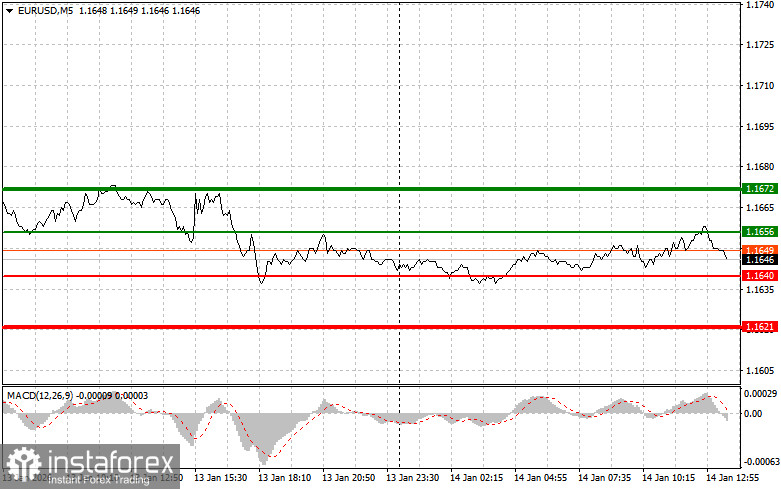
What's on the chart:
Important. Beginner Forex traders need to be very cautious when making market entry decisions. Ahead of major fundamental reports, it is best to stay out of the market to avoid sharp price fluctuations. If you decide to trade during news releases, always place stop-loss orders to minimize losses. Without stop-loss orders, you can very quickly lose your entire deposit, especially if you do not use proper money management and trade large volumes.
And remember, successful trading requires a clear trading plan, like the one presented above. Spontaneous trading decisions based on the current market situation are an inherently losing strategy for an intraday trader.


