
Vea también


 02.06.2026 04:26 AM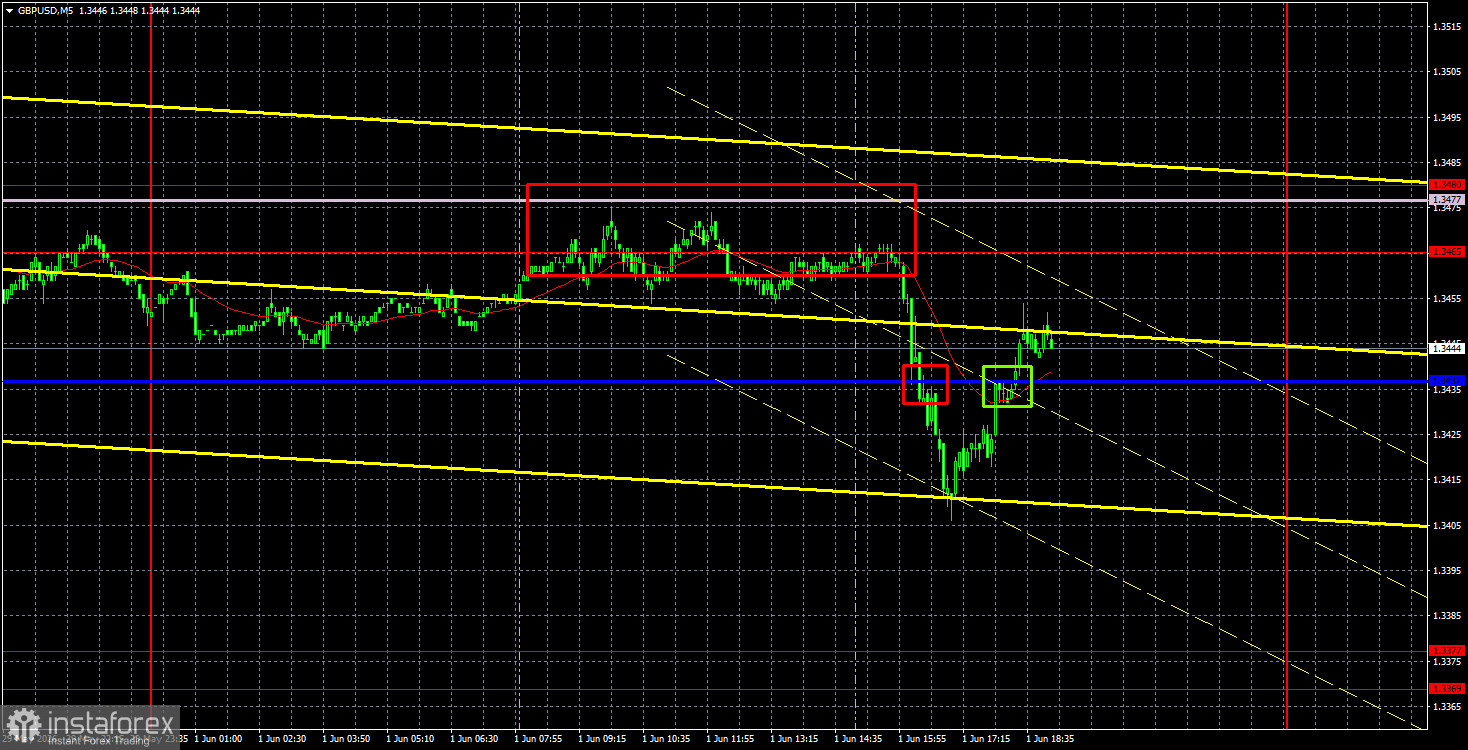
The GBP/USD currency pair also moved lower on Monday, but the decline was short-lived, with the British pound returning to its initial levels by evening. Once again, traders failed to break through the area of 1.3465-1.3480 in conjunction with the Senkou Span B line. Thus, the pound has, on one hand, started a downward trend, but on the other hand, remains in a sideways channel of 1.3377-1.3480, and on a third note, cannot initiate a decline. On Monday, the macroeconomic calendar for the UK was empty, while in the US, the ISM Manufacturing Index was released, showing stronger-than-expected results. Consequently, the rise of the US dollar was quite logical, but the subsequent bounce upward indicated that bears are just as uncertain about their actions as bulls are. Neither party wishes to take risks amid global geopolitical uncertainty.
From a technical standpoint, the downward trend began after the price surpassed the trend line, but in recent weeks, the price has been tightly stuck between 1.3369-1.3377 and 1.3465-1.3480. The upper boundary of this channel could not be overcome, so a move towards the lower boundary may be observed in the near future. Geopolitics remains uncertain, so until the situation clarifies, the pound may remain within the sideways channel.
On the 5-minute timeframe on Monday, three trading signals were generated. At the beginning of the US trading session, the price bounced from the area of 1.3465-1.3480 and then surpassed the Kijun-sen line, but failed to continue falling, returning to that area by evening. Thus, traders could have opened a short position initially and then a long position, both of which turned out to be profitable, albeit with small gains.
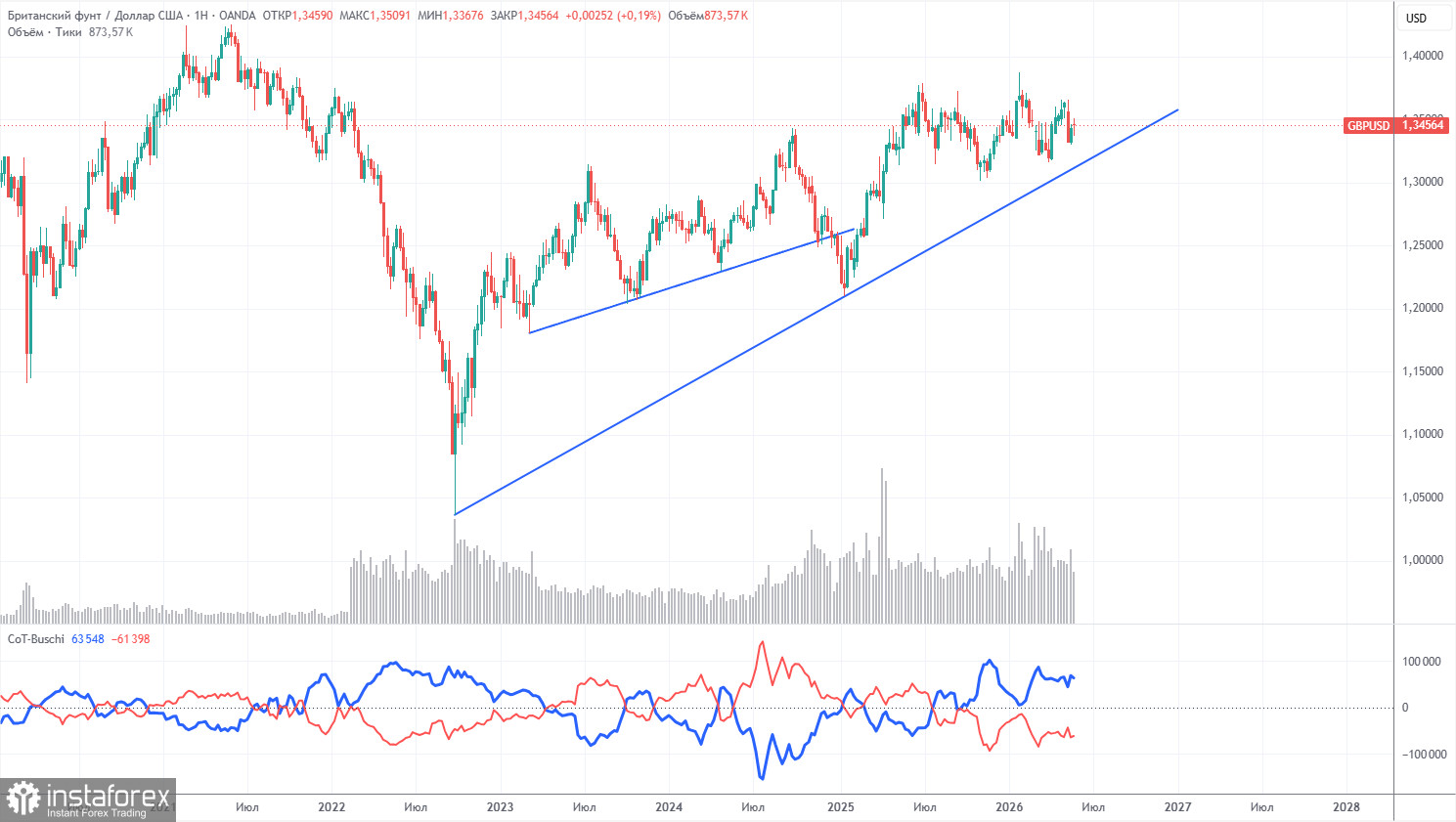
COT reports for the British pound show that commercial traders' sentiment has been changing steadily in recent years. The red and blue lines representing the net positions of commercial and non-commercial traders consistently intersect and are mostly close to the zero mark. Currently, the lines are diverging, with non-commercial traders still dominating with... sales. Given the events in the Middle East, it is no surprise that demand for riskier currencies is falling while demand for the dollar is increasing.
In the long term, the dollar continues to decline due to Trump's policies, which are clearly visible on the weekly timeframe (illustration above). The trade war will continue in one form or another for a long time, and Trump's policies are both directly and indirectly aimed at weakening the American currency. However, geopolitical factors have taken precedence, providing strong support for the dollar recently. Since the conflict in the Middle East cannot be considered resolved, the US dollar could still show growth in the future. According to the latest COT report (as of May 26), the "Non-commercial" group closed 10,100 BUY contracts and 13,000 SELL contracts. Thus, the net position of non-commercial traders increased by 3,100 contracts over the week.
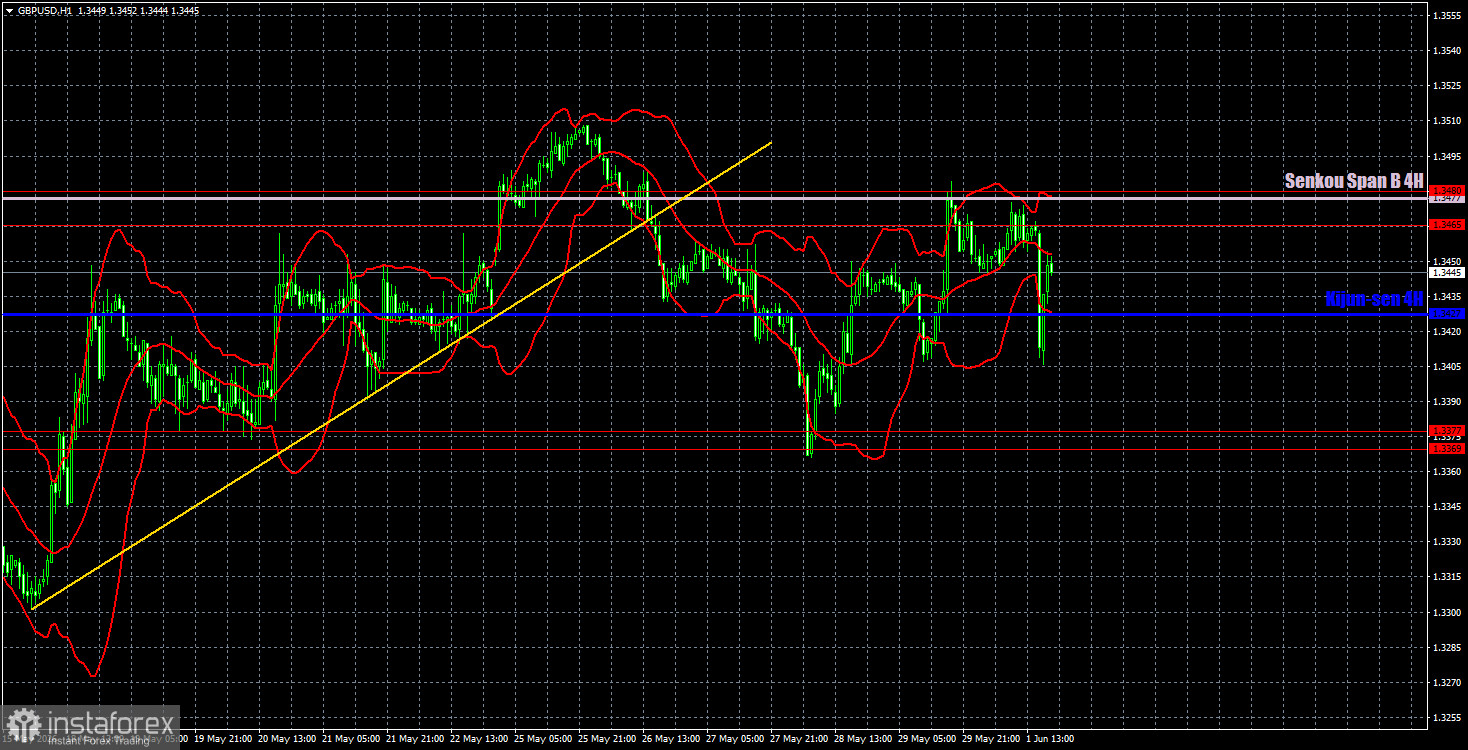
On the hourly timeframe, the GBP/USD pair has ended its upward trend due to renewed escalation around the Strait of Hormuz. The macroeconomic and fundamental factors still have little impact on the pair's movements. We do not believe that, without a real escalation of the conflict in the Middle East, the dollar can show strong growth. The American currency can only rely on a breakdown in negotiations between Iran and the US.
For June 2, we highlight the following important levels: 1.3096-1.3115, 1.3179-1.3187, 1.3369-1.3377, 1.3465-1.3480, 1.3588, 1.3671-1.3681, and 1.3751-1.3763. The Senkou Span B (1.3477) and Kijun-sen (1.3427) lines may also serve as sources of signals. It is recommended to set a Stop Loss to break even when the price moves in the correct direction by 20 pips. The Ichimoku indicator lines may shift throughout the day, which should be taken into account when determining trading signals.
On Tuesday, no significant events are scheduled in the UK, while in the US, a JOLTS report on job openings will be released, which we do not consider important. The price is unlikely to exit the sideways channel without serious geopolitical events.
Today, traders can open short positions targeting 1.3369-1.3377 if the pair bounces from the 1.3465-1.3480 area. Long positions will become relevant after overcoming the 1.3465-1.3480 area, with a target at 1.3588.
Price levels of support and resistance – thick red lines where movement may stop. They are not sources of trading signals.
Kijun-sen and Senkou Span B lines – Ichimoku indicator lines transferred from the 4-hour timeframe to the hourly timeframe. They are strong lines.
Extreme levels – thin red lines where the price previously bounced. They are sources of trading signals.
Yellow lines – trend lines, trend channels, and any other technical patterns.
Indicator 1 on COT charts – the size of the net position for each category of traders.


