
Vea también


 03.06.2026 07:10 PM
The wave pattern on the 4-hour chart for EUR/USD has changed. There is still no reason to speak of the cancellation of the bullish trend segment (shown in the lower chart), which began in January of last year. However, the trend structure has now taken on a corrective form. From a long-term perspective, a Wave C can be expected, with its low positioned below the low of Wave A.
At the moment, it is difficult to believe in such a substantial decline of the euro, but the first quarter of 2026 demonstrated that geopolitical developments can dramatically alter market trends.
On the lower time frame, I can identify a classic three-wave bullish corrective structure. Following the completion of this structure, a new downward trend segment began to form, which, logically, should be impulsive in nature. If this assumption is correct, we can expect a five-wave structure within higher-degree Wave C, with targets below the 1.1400 level.
Are there sufficient fundamental reasons to expect such a strong appreciation of the U.S. dollar? Not conclusively. However, the market is increasingly losing confidence in the prospect of a deal between the United States and Iran, which is supporting dollar buyers.
The EUR/USD pair declined by 30 basis points on Wednesday and is gradually moving toward the formation of a new downward wave, which may be identified as the fifth wave within the current bearish structure. If this interpretation is correct, only one conclusion can be drawn: the market has largely abandoned hopes for a peace agreement between Iran and the United States and is once again shifting toward safe-haven assets and currencies.
The recent decline in the cryptocurrency market indirectly supports this view. Traders are once again reducing risk exposure, as hopes for a lasting ceasefire in the Middle East continue to fade.
I do not even wish to list today's geopolitical headlines. They offer nothing fundamentally new or particularly informative. Every day, traders receive the same collection of conflicting reports or statements that fail to reflect objective reality.
At the same time, there has been very little economic data released today, and the market continues to pay limited attention to macroeconomic indicators. For example, yesterday's Eurozone inflation report was largely ignored despite significantly increasing the likelihood of European Central Bank monetary tightening next week.
Even the prospect of a rate hike in the Eurozone in June, while neither the Federal Reserve nor the Bank of England is expected to raise rates, has provided no meaningful support for the euro. The market is simply ignoring economic factors and remains skeptical about a peaceful resolution of the conflict in the Middle East.
As a result, we are seeing a moderate strengthening of the U.S. dollar, which is fully consistent with the current wave structure.
What should be expected after the completion of the fifth wave? In my view, at least a three-wave bullish sequence will begin to form, and its strength will once again depend on geopolitical developments. Nothing has changed in that regard.
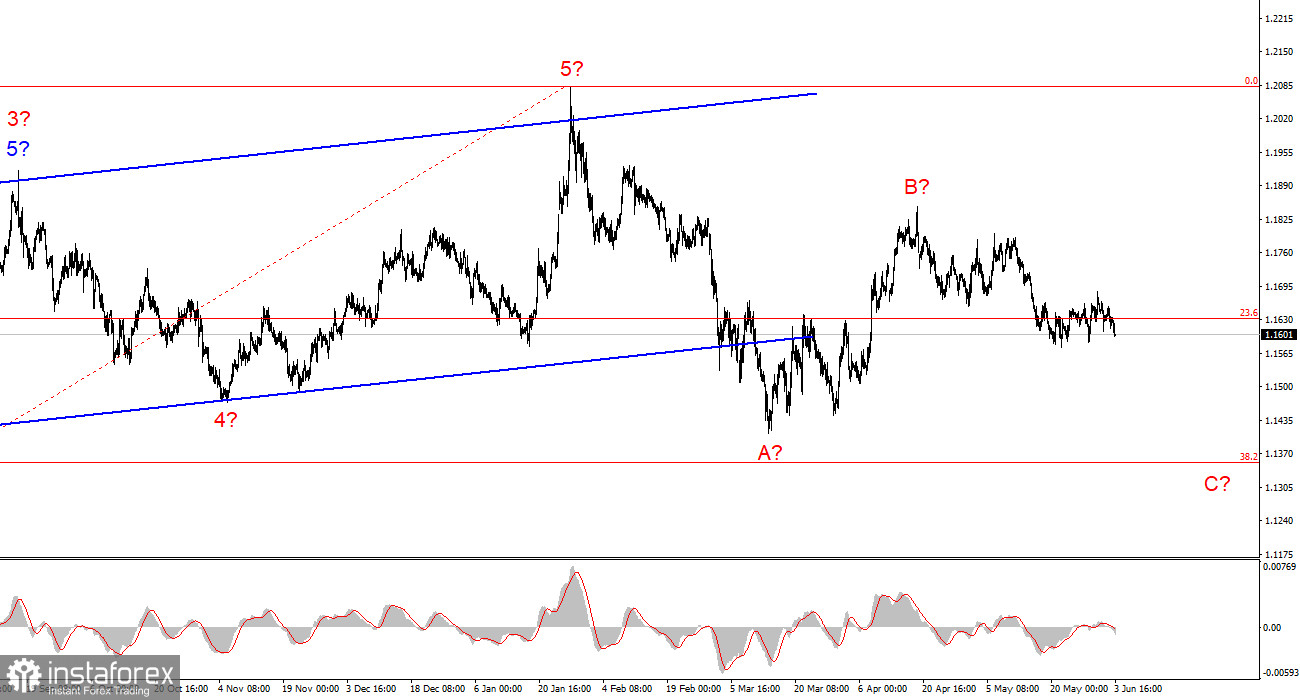
Based on my EUR/USD analysis, I conclude that the instrument remains within a broader bullish trend segment (lower chart) and, in the shorter term, within a corrective structure. At present, Wave 5 may be developing as part of Wave C.
The entirety of Wave C, if the current wave count is correct, may ultimately complete its formation well below the 1.1400 level. However, such a significant decline would require substantial support from geopolitical factors. Otherwise, the bearish wave sequence may become truncated and complete slightly below the 1.1600 level.
On the higher time frame, a bullish trend segment remains visible, followed by the development of a corrective wave structure. In the near future, Wave C is expected to form with targets near 1.1352, corresponding to the 38.2% Fibonacci retracement level.
Once the A-B-C corrective structure is completed, a new long-term bullish trend may begin.
Key Principles of My Analysis


