
আরও দেখুন


 20.07.2026 03:44 PM
The change of prime minister in the United Kingdom took place without disruption, with Andy Burnham officially assuming office on July 20. Markets reacted positively: the pound strengthened for a third consecutive week, while GBP/USD closed at 1.3466, up 0.4%. Reports that centrist Shabana Mahmood, rather than the more left-leaning Ed Miliband, would be appointed Chancellor of the Exchequer eased concerns over a sharp increase in government spending.
The macroeconomic backdrop remains mixed. The UK economy expanded by 0.1% month-on-month in May after contracting by 0.1% in April. Over the three months through May, GDP grew by 0.7%, exceeding the consensus forecast of 0.5%. However, the entire increase was driven by the services sector, which expanded by 0.3%, while industrial production declined by 0.5% and construction output fell by 0.8%. Annual inflation remained unchanged at 2.8% in May, while core inflation accelerated to 2.6% and services inflation climbed to 3.7%.
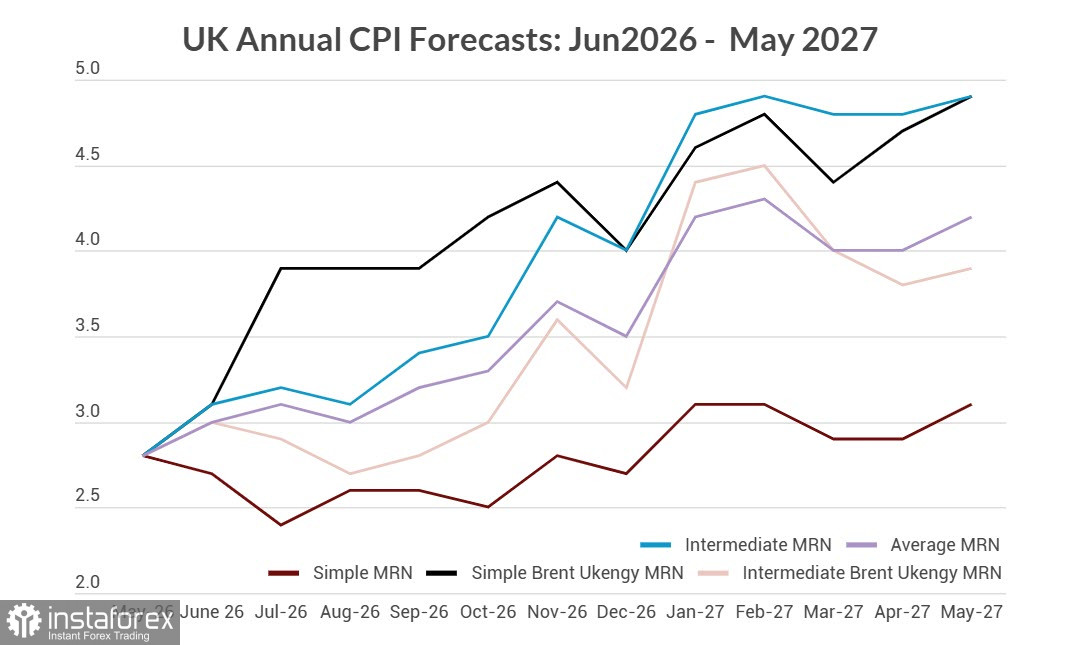
The National Institute of Economic and Social Research (NIESR), which uses an advanced neural network model to forecast inflation, sees increasing evidence that inflation could rise to 4.5% by early 2027.
Overall industrial production declined by 0.5% month-on-month in May, while markets had expected a decline of only 0.1%. This marked the first monthly contraction since January. On an annual basis, industrial output increased by 1.0%, falling short of expectations. For the Bank of England (BoE), the report delivered mixed signals. Structural weaknesses in the industrial sector do not eliminate inflationary pressures, as the primary driver of inflation is currently geopolitically driven energy prices rather than domestic industrial activity. For GBP/USD, the report should be viewed as moderately negative.
The OECD expects inflation to accelerate to 4.0% in 2026 due to the energy shock, reinforcing the need for a hawkish stance from the BoE. In June, the Bank Rate was left unchanged at 3.75% in a 7–2 vote, with two policymakers favoring a rate hike. Markets are currently pricing in a first increase to 4.00% in September and a second hike to 4.25% by the end of the year.
The escalation of the conflict between the United States and Iran has reached a new stage. By July 20, the United States had already carried out a ninth wave of airstrikes, while Iran responded with missile attacks against U.S. allies in the region, including Bahrain and Kuwait. Persistently high energy prices remain the key challenge for the Bank of England, which has already acknowledged that it will be unable to prevent further price increases.
Net short positioning in the pound decreased by £1.4 billion during the latest reporting week to -£5.9 billion. Sterling has improved its positioning for a third consecutive week, while its estimated fair value remains close to its long-term average and is attempting to extend its recovery.
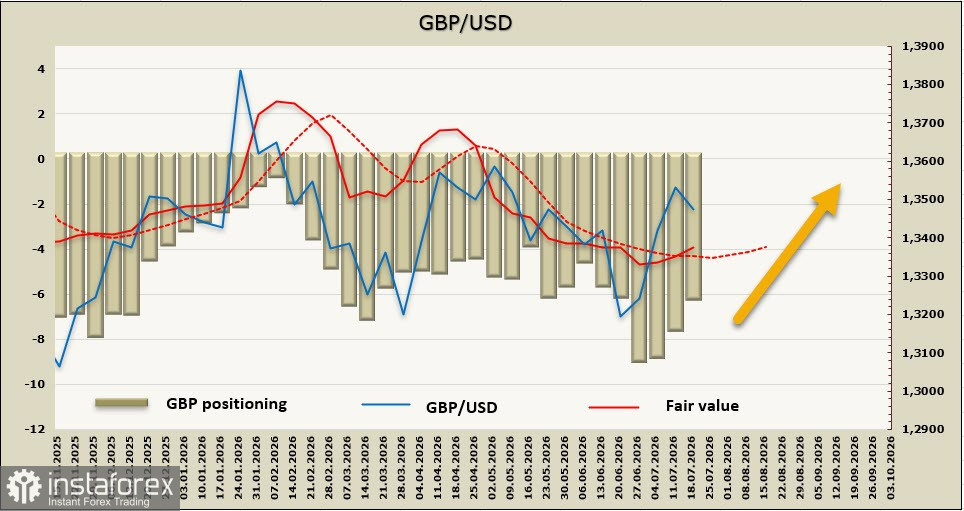
Although the U.S. dollar remains the world's primary safe-haven currency, it has been unable to regain ground against the pound for a third consecutive week despite the latest escalation in geopolitical tensions. We expect the current corrective recovery to extend toward the 1.3550 level in the short term. However, a sustained move above 1.3600 appears unlikely given ongoing geopolitical risks and uncertainty surrounding inflation. A more probable scenario is that the pair encounters resistance in the 1.3485–1.3500 level before resuming its decline, initially targeting 1.3300 and, over the longer term, the 1.3000–1.3030 level.


