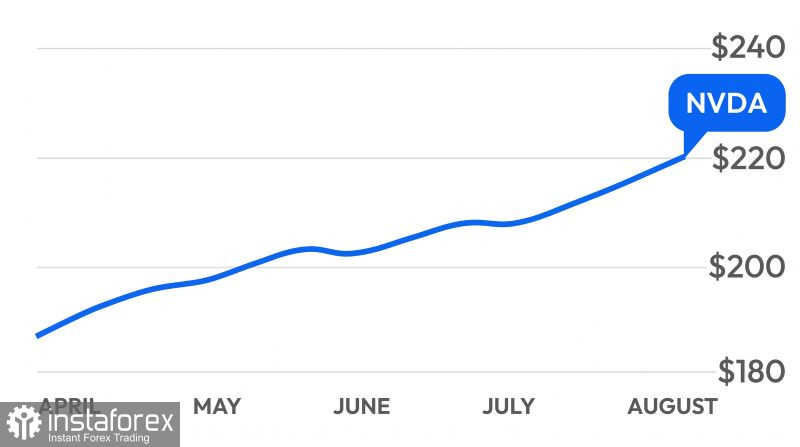
The company posted record quarterly revenue of $96.2 billion, beating analyst estimates of $92.2 billion and representing a 106% year-over-year increase. The data center chip segment generated a record $89 billion, up 117% year-over-year. Diluted earnings per share (EPS) reached $2.22 versus the expected $2.10.
Company leadership issued strong forward guidance. For the third quarter, revenue is projected to be between $105.8 billion and $110.2 billion. CFO Colette Kress stated that revenue will grow by 70% in fiscal year 2028, whereas market consensus anticipated just 44%. CEO Jensen Huang noted that AI infrastructure has entered a phase of direct return on investment, with aggregate tech industry spending on data centers expected to grow from $800 billion this year to $1.3 trillion next year.
Additional tailwinds came from new agreements and product launches. Nvidia secured a deal with Amazon to supply 2 million GPUs through 2028. Analyst Ming-Chi Kuo reported the relaunch of the specialized Rubin CPX accelerator, designed for preliminary user query preprocessing before response generation. Mass production in standalone server rack form factors is scheduled for Q1 2027. Following these announcements, investment banks sharply raised their price targets: Raymond James expects $515, Evercore ISI projects $465, Bernstein set a target of $400, and Morgan Stanley established a target of $300 per share.
Key Headwinds
Despite record profitability and optimistic guidance, the stock faces several notable pressures:
September Stock Market Slump: Historical data since 1971 shows that the tech-heavy Nasdaq index declines 48% of the time in September, with an average return of -1%. Investment fund managers returning from summer vacations frequently take profits and liquidate their most liquid holdings ahead of the fiscal year-end. Having significantly outperformed the broader market, Nvidia faces active profit-taking and selling pressure.
Memory Shortages and Margin Compression: Scarcity in high-bandwidth memory has driven up component costs, prompting the company to increase finished server prices by 15%. Rising manufacturing costs are projected to compress Q4 gross margins to 71–72% (down from 73%), reducing net revenue per server sold. Key memory supplier Micron Technology's late-September earnings report will reveal the ongoing severity of the shortage.
Round-Tripping Allegations and Regulatory Scrutiny: Investor Michael Burry and other skeptics have scrutinized Nvidia's $3.5 billion investment in MediaTek and $105 billion in deal guarantees for OpenAI. Critics allege the chipmaker finances third-party companies that in turn use those funds to purchase Nvidia hardware. The Wall Street Journal also reported that Nvidia paused its cloud partner revenue-sharing program amid antitrust inquiries.
New Tariff Threats and Loss of the Chinese Market: The Donald Trump administration is preparing new semiconductor import tariffs, which will raise AI infrastructure deployment costs. Due to existing export restrictions, Nvidia's data center revenue from China has dropped to zero, and the company excludes the Chinese market from its forward estimates.
Rising Treasury Yields and Elevated Oil Prices: Federal Reserve Chair Kevin Warsh signaled that interest rates will remain higher for longer, pushing 10-year US Treasury yields to 4.75%. Simultaneously, geopolitical escalation in the Strait of Hormuz lifted oil prices above $90 per barrel. Higher sovereign yields bolster the appeal of risk-free assets and dampen investor demand for high-valuation tech equities.
Outlook
Nvidia's stock trajectory through year-end 2026 will likely unfold in two stages:
September 2026: Institutional profit-taking and broader market seasonality will weigh on share prices. Elevated interest rates and tariff risks will limit new capital inflows. A pullback from the current $220.78 level toward the $200–$210 support zone remains probable. A rapid ascent toward the $300 analyst target is unlikely until the seasonal selling pressure subsides.
Q4 2026 Recovery: Demand for next-generation Vera Rubin and Rubin CPX architectures is supported by the tech sector's $1.3 trillion capital expenditure plans. The Amazon partnership and stabilizing memory supply chains should help maintain top-line growth above 70%. Following the September consolidation, Nvidia shares are poised to resume their rally and close 2026 within the $250–$270 range.
You have already liked this post today
*The market analysis posted here is meant to increase your awareness, but not to give instructions to make a trade.



 01.09.2026 09:32 AM