
See also


 01.09.2026 09:09 AM
Already today, Brent rose by 1.1 percent to $91.51 per barrel, approaching the $92 mark, while WTI gained 1.4 percent to $86.99 after a 2.8 percent increase on Monday.
The cause was the first exchange of strikes between the U.S. and Iran in about a month: U.S. forces attacked an island in the Strait of Hormuz, and Iran responded with strikes on the United Arab Emirates and Jordan. Notably, August ended with only a symbolic gain for oil after an exceptionally volatile month, during which prices oscillated amid sporadic attempts to end the war, including U.S. promises to undermine the Iranian economy. President Trump dismissed concerns that the conflict was draining American firepower, characterizing the situation as "a relatively small war for us."
Iranian strikes targeted U.S. air bases in Jordan; however, local media reported that the missiles were intercepted and destroyed before causing any damage. Trump stated on Monday that the U.S. would respond to attacks against American forces, opening the prospect of a new cycle of military escalation.
Many experts anticipate further upward price movements for oil, as there are no signs that normal transit through the Strait of Hormuz will resume in the near term. It is worth noting that several current and former American and Iranian officials also expect the conflict to drag on for months.
Perhaps the most intriguing aspect of the current situation is how the market has adapted to the blockade. Oil exports continue through the Strait of Hormuz, often on tankers with transponders turned off to avoid detection. Producers in the Persian Gulf, including the UAE, Saudi Arabia, Kuwait, and Iraq, continue to export barrel after barrel. Nevertheless, vessels passing through the strait face a constant threat of attack.
Additionally, the real epicenter of price pressure has shifted from crude oil to refined products. Fighting in the Middle East, combined with the ongoing conflict in Ukraine, has led to prices for refined products rising significantly faster than for crude oil, particularly for diesel fuel. It's worth noting that the margin for producing diesel from oil in the U.S. recently exceeded $100 per barrel, reaching a historic record.
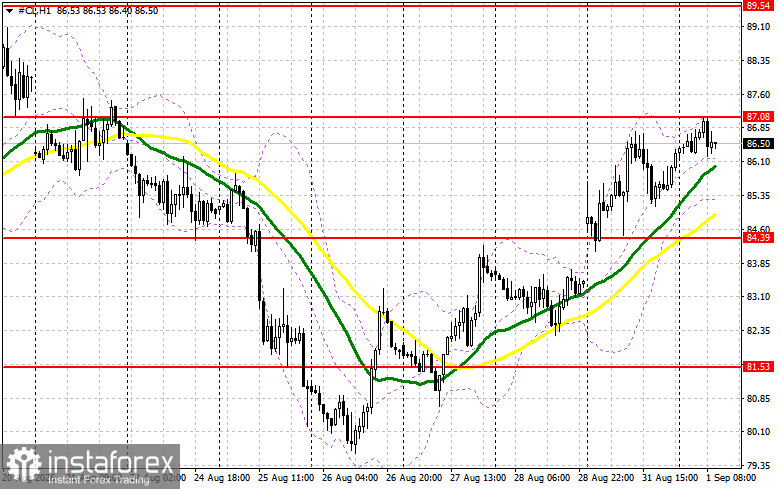
Regarding the current technical picture for oil, buyers need to conquer the nearest resistance at $87.10. This will allow them to target $89.54, beyond which it will be quite challenging to break through. The furthest target will be the $92.54 area. In the event of a decline, bears will try to take control of $84.39. If they succeed, breaking this range will deliver a serious blow to bulls' positions and could push oil down to a low of $81.53, with the potential to reach $78.70.


