
یہ بھی دیکھیں


 16.07.2026 04:30 AM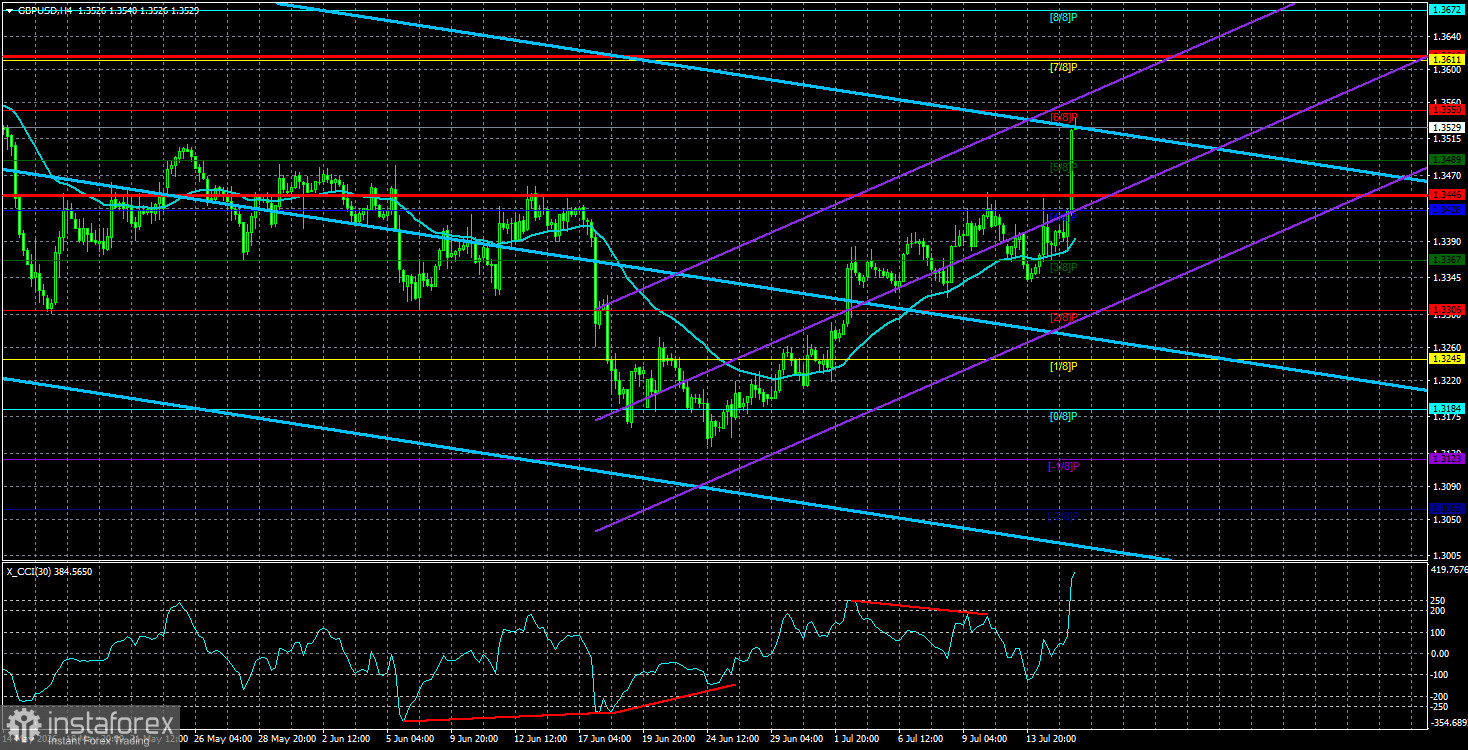
The GBP/USD currency pair surged upward on Wednesday for no apparent reason. On Tuesday, the pound also exhibited volatility of more than 100 pips, which can be easily explained by a resonant inflation report. Traders expected U.S. inflation to slow to 3.8%, but the actual figure was 3.5%. The market's "hawkish" expectations for the next two meetings immediately diminished, but the U.S. dollar may still show some growth in the coming days. There are no significant events scheduled for the rest of the week in either the U.K. or the U.S., so it's an ideal time for a correction after three weeks of growth.
Overall, the future of the British pound now depends on geopolitics and the actions of the Bank of England and the Federal Reserve. The actions of the BoE and the Fed, in turn, also depend on geopolitics. Analysts can currently only speculate about the decisions central banks will make by the end of the year. The games of "Guess the Melody" and "Battle of Psychics" have begun. Every expert feels obliged to report that the likelihood of tightening has increased or decreased; it doesn't matter. However, no one mentions that everything will depend solely on oil prices, which are determined by the situation around the Strait of Hormuz. Thus, we see no sense in guessing what the actions of the BoE and the Fed will be until the end of the year. The situation is such that reactions must be based on circumstances.
Of course, if inflation in Great Britain continues to rise, the British central bank will also be forced to consider tightening monetary policy. But the point is that no one knows whether inflation will rise. Will it reach levels that require the BoE's intervention? The level of uncertainty is currently off the charts. Andrew Bailey has never ruled out raising rates, but the inflation data over the past few months does not warrant policy tightening. Therefore, at this time, the BoE has the opportunity to wait and observe.
In contrast, inflation in the U.S. has already begun to decrease. If another conflict in the Middle East can be "smoothed over," inflation will continue to slow. In this case, the Fed will not need to raise the key interest rate. We want to say that the "dot plot," expert forecasts, and half-hints from representatives of the Fed and the BoE mean nothing at the moment, as the situation can change in the blink of an eye.
Of all central banks, only the European Central Bank takes a clear position. According to Christine Lagarde, damage has already been done to the European economy, so the central bank may raise rates again in 2026. At least the ECB has a clear stance on interest rates. But even that may undergo changes if inflation continues to decline.
We still do not expect strong growth in the U.S. dollar, even if the Fed begins to tighten policy. The GBP/USD pair has been trading within a sideways channel on the weekly timeframe for a year. Inside this channel, it will likely remain for the foreseeable future. Since the trend from 2022 persists, we continue to expect only long-term growth.
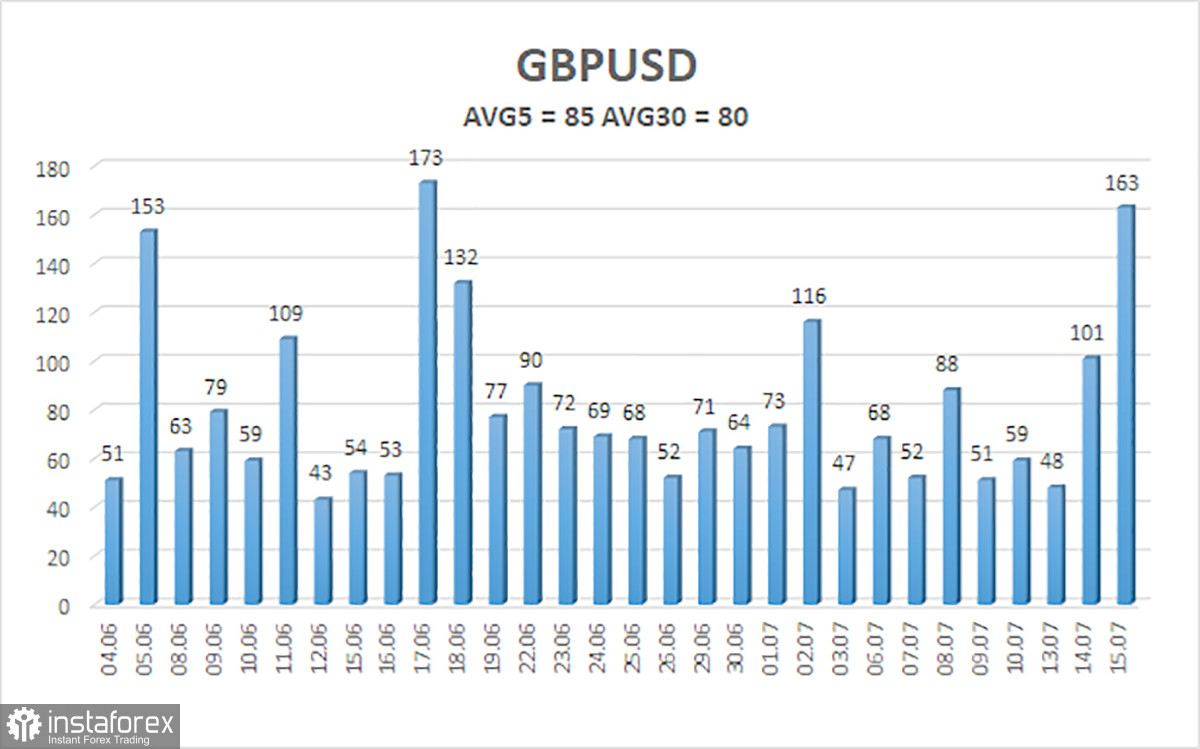
The average volatility of the GBP/USD pair over the last 5 trading days is 85 pips. For the pound/dollar pair, this value is considered "average." On Thursday, July 16, we expect movement within a range bounded by levels 1.3446 and 1.3616. The upper linear regression channel is directed downward, indicating a downtrend. The CCI indicator has formed a "bearish" divergence and has entered the overbought area – a downward correction is approaching.
S1 – 1.3489
S2 – 1.3428
S3 – 1.3367
R1 – 1.3550
R2 – 1.3611
R3 – 1.3672
The GBP/USD currency pair maintains a downtrend. Trump's policies will continue to put pressure on the U.S. economy, so we do not expect growth from the U.S. dollar in the long term. The year 2026 looks super positive for the dollar due to geopolitics and, now, the Fed's readiness to raise the key interest rate. However, a flat continues on the weekly timeframe between levels 1.3150 and 1.3780 within a four-year uptrend. Long positions with targets at 1.3611 and 1.3616 can be considered when the price is above the moving average. If the price is below the moving average line, trading on the downside can be considered with a target at 1.3306.
Linear regression channels help determine the current trend. If both are directed in one direction, it means the trend is strong;
The moving average line (settings 20,0, smoothed) determines the short-term trend and the direction in which trading should currently be conducted;
Murray levels are target levels for movements and corrections;
Volatility levels (red lines) represent the likely price channel in which the pair will move over the next day based on current volatility indicators;
The CCI indicator's entry into the oversold zone (below -250) or overbought zone (above +250) indicates that a trend reversal in the opposite direction is approaching.


