
Vea también


 01.09.2026 09:52 AM
Bitcoin and Ethereum have shown a rapid rise, which has now clearly started to fade. The US Treasury's decision to increase its bond repurchase volumes triggered a surge in the cryptocurrency market, but we're still wondering how long this will last, considering it relies on a single supportive factor. Essentially, it was a "black swan" that appeared unexpectedly. Despite the strong growth of both cryptocurrencies, we do not believe that the downward trend is over. The fundamental background remains weak for the crypto segment, and the downward trends in both Ethereum and Bitcoin have not been broken. We still do not observe grounds for sustained growth. The prospects for the cryptocurrency industry have become much more optimistic, but we caution traders: we may be dealing with a pump or manipulation.
Meanwhile, Ray Dalio, founder of Bridgewater Associates and well-known in the cryptocurrency world for his statements and predictions, urged investors to sell government bonds and diversify portfolio risks amid the US debt crisis. There is nothing surprising about such advice from a billionaire, as the US debt crisis is a topic that only the lazy is not discussing right now. However, we would like to note that the enormous debt of the United States did not arise overnight but has been building for a long time. By the time Donald Trump assumed office for his second term, it already stood at $37 trillion. Trump achieved the near-impossible by increasing it to $40 trillion. However, the difference between $37 trillion and $40 trillion is not that significant.
The problem now is that few investors want to deal with long-term government bonds without Ray Dalio's advice. It is clear that such a debt burden will lead to adverse outcomes, and Donald Trump's policies remain protectionist and focused more on his personal interests. The American government needs to pay $1 trillion annually just in interest. Thus, there is a risk of rising national debt due to the servicing of the debt itself, followed by geometric progression. So, it's not surprising to hear such advice.
The question remains whether Bitcoin is the instrument to use during difficult economic times to preserve capital. In our opinion, certain investments in Bitcoin would be prudent. Mr. Dalio also recommends holding "a little Bitcoin" in a portfolio. However, we want to remind you that investing and trading are different things. Bitcoin could still fall to $50,000 this year.
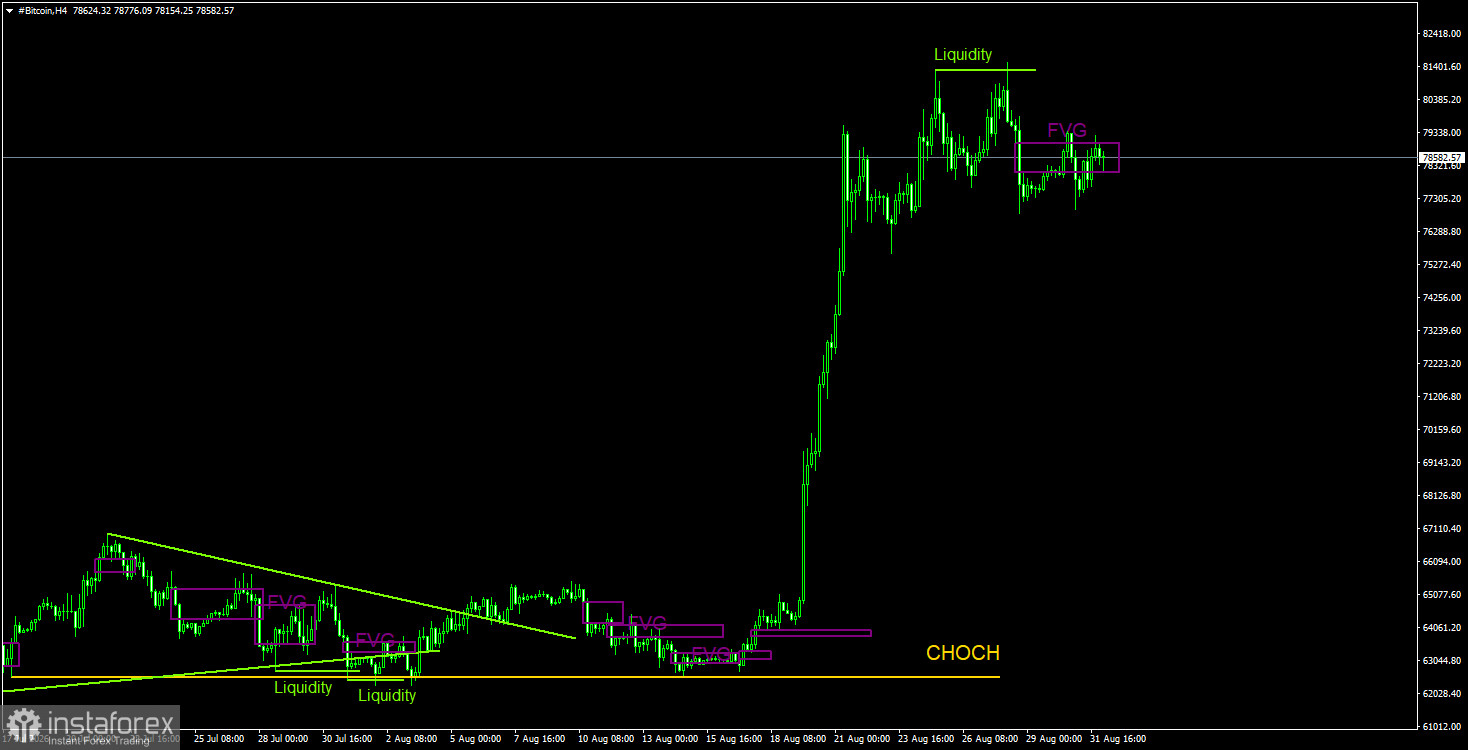
Bitcoin continues to form a downward trend, despite strong growth from the previous week. We maintain expectations for a decline with a target of $57,500 (the 61.8% Fibonacci level from a three-year upward trend), although this level has essentially already been tested. However, we do not think the downward trend is over. The current rise of the leading cryptocurrency hardly resembles a correction, but this cannot be a convincing reason for opening longs. The current movement resembles pumping the most. Liquidity may be taken from the peak of $82,850, which could provoke a decline in the leading cryptocurrency and confirm a transition to sideways movement. On the 4-hour timeframe, a new round of decline is expected from the last "bearish" FVG.
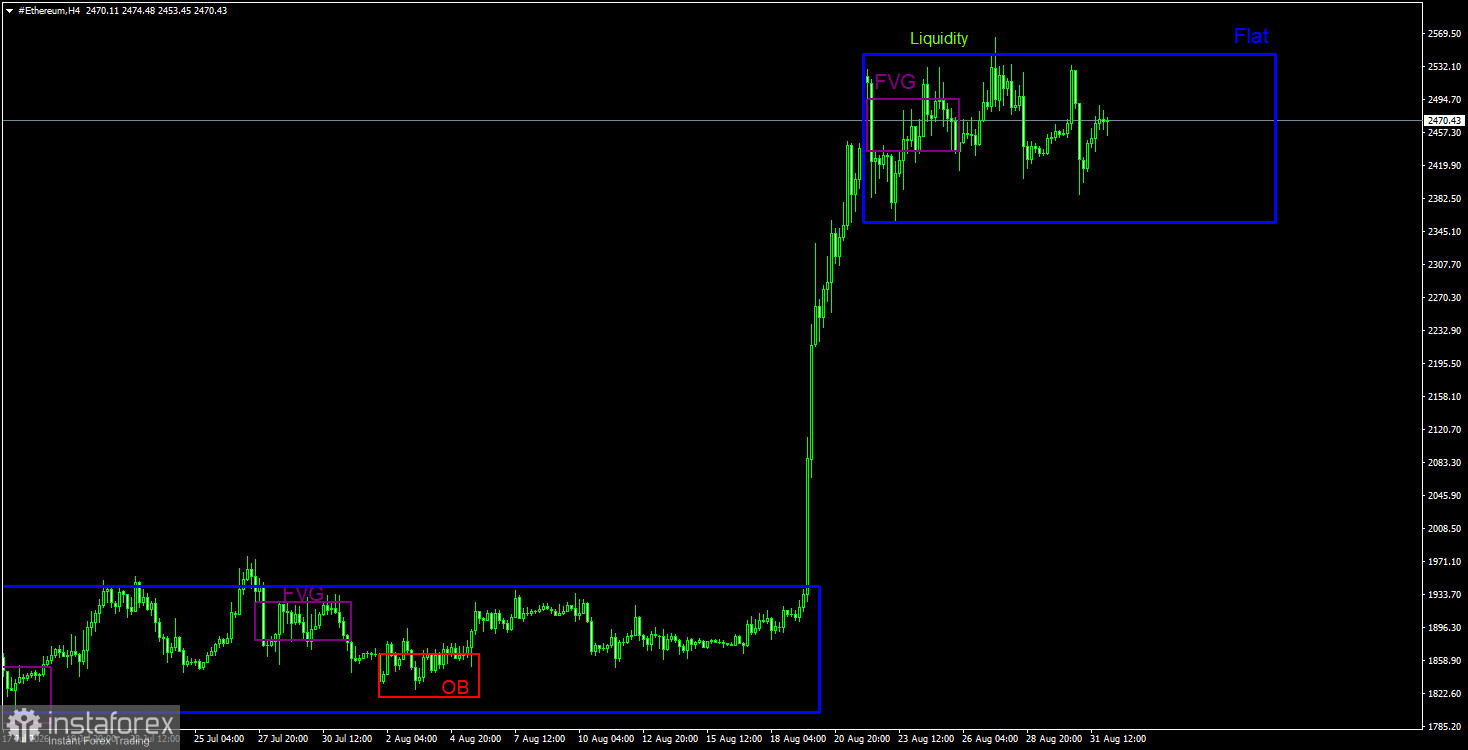
On the daily timeframe, the technical picture has changed completely in just a few days. Now, Ethereum may start a new upward trend. However, traders can only base their moves on the weekly chart, where Ethereum may target $4,800, which represents the upper boundary of the five-year sideways channel. On the daily timeframe, the nearest "bearish" FVG has been tested, but this FVG belongs to the previous trend. If it provokes a market reaction, it will likely be corrective. We also note the liquidity taken from the peak of April 17 and the liquidity taken on the 4-hour timeframe. Bitcoin has also taken liquidity on the 4-hour chart. Thus, at the very least, a correction is brewing, but on the 4-hour timeframe for Ethereum, a flat formation has already emerged, and Bitcoin is also in no hurry to begin its decline.
CHOCH is a change of character / break of the trend structure. Liquidity means traders' Stop?Losses that market?makers use to build their positions. FVG is Fair Value Gap (area of price inefficiency). The price often moves quickly through such areas, indicating the absence of one side in the market. Later, the price tends to return and react to these zones. IFVG stands for Inverted Fair Value Gap. After a return to such a zone, the price does not react but impulsively breaks through and then tests it from the other side.
OB means Order Block. A candle on which a market?maker opened a position in order to harvest liquidity and then form their own position in the opposite direction.


